







Ume vs. Sakura: How Japan’s Two Spring Blossoms Changed Places
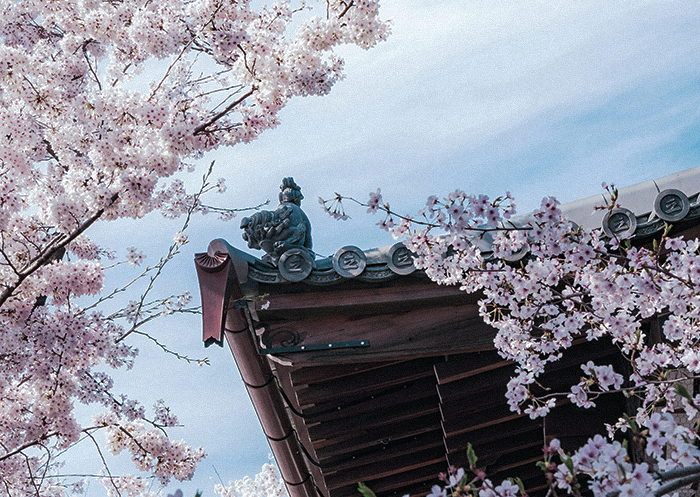
Two flowers announce spring in Japan, and they do not arrive together. 梅 ume, the plum blossom, opens first, from late January into early March. 桜 sakura, the cherry blossom, follows from late March into April. Both are treated as beloved. Neither has stayed in the same place in Japanese life across the centuries — their origins, their standing, and even which one people gathered to admire have shifted over well over a thousand years. This article follows that shift, flower by flower.
Sakura: A Native Flower With a Disputed Name
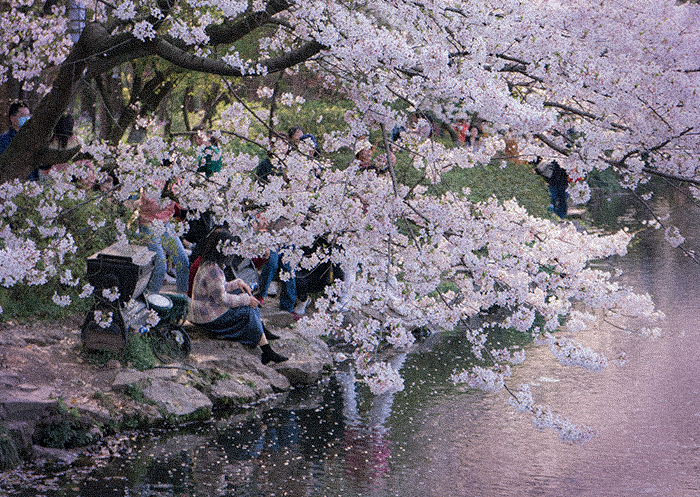
Sakura has grown wild across Japan since antiquity. Three species are usually named as the country’s classic wild cherries: ヤマザクラ Yamazakura, エドヒガン Edohigan, and オオシマザクラ Oshima-zakura. A cultivated form, 枝垂桜 shidarezakura, the weeping cherry, appeared later.
Sakura was never formally designated Japan’s national flower, yet the association between sakura and Japan is fixed worldwide all the same — reinforced by how often the word turns up in girls’ names, place names, and school names across the country.
The origin of the word itself is disputed. Three explanations are commonly offered:
– 咲く saku, “to bloom,” with the plural suffix ら ra attached.
– A combination of サ神 sa-gami, the deity of the rice paddies, and クラ kura, the seat a deity descends to — the idea being that cherry blossoms once opened at the same time of year as rice planting.
– A shift from 佐久夜 sakuya, part of the name 木花之佐久夜毘売 Konohana no Sakuya-hime, a goddess described as a woman of unrivaled beauty and the great-grandmother of Japan’s legendary first emperor, Jinmu.
Someiyoshino: A Nineteenth-Century Invention
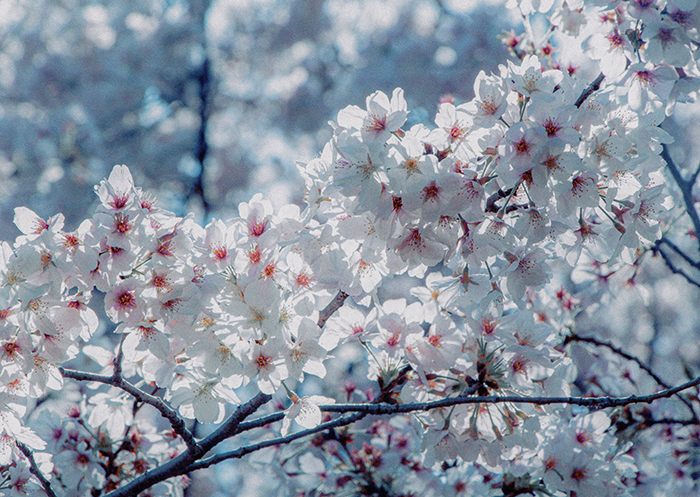
When people picture sakura today, they are usually picturing ソメイヨシノ Someiyoshino, the variety that dominates Japan’s cherry trees in the present day. It is not ancient. Someiyoshino was bred by hand in the late Edo period (1603–1868), by gardeners working in Somei village — now the Sugamo and Komagome area of Toshima ward, Tokyo. Its parentage is given as Edohigan on the mother’s side and Oshima-zakura on the father’s.
At first the new variety was called simply 吉野 Yoshino or 吉野桜 Yoshinozakura, after Yoshino, the mountain in Nara long celebrated as a cherry-blossom destination. To avoid confusing it with the actual wild Yamazakura growing on that mountain, breeders renamed it Someiyoshino, adding the place of its own origin to the name.
From the mid-1950s, during Japan’s postwar period of rapid economic growth, Someiyoshino was planted in huge numbers across the country. That is largely why the Japan Meteorological Agency now uses a designated Someiyoshino tree — a 標本木 hyohonboku, “sample tree” — in each region to judge the opening and full bloom of the cherry blossom season every year.
The variety also has an international history. In 1912, Someiyoshino and another variety, カンザン Kanzan, were sent to Washington, D.C. as a gesture of friendship between Japan and the United States — the origin of the cherry trees now familiar around the Tidal Basin.
Yoshino: The Mountain That Gave the Variety Its First Name
Yoshino, in Nara prefecture, has been treasured as a cherry-blossom destination since long before Someiyoshino borrowed its name. It sits within reach of the old capitals of Heijo-kyo and Heian-kyo, and mountain worship long held it to be an ideal realm inhabited by gods and mountain ascetics.
Roughly 1,300 years ago, En no Gyoja, regarded as the founder of Shugendo, Japan’s mountain ascetic tradition, is said to have carved an image of the deity 蔵王権現 Zao Gongen into a cherry tree and enshrined it at Yoshino. The tree that carried the carving came to be revered as a sacred tree for later generations, and cherry trees were planted at Yoshino as votive offerings ever since.
The dominant species at Yoshino is シロヤマザクラ Shiroyamazakura, white mountain cherry, and the sight of the mountain in bloom earned it the names 一目千本 hitome senbon, “a thousand trees at a glance,” and 吉野千本桜 Yoshino senbonzakura, “Yoshino’s thousand cherry trees” — a description of how splendid it looks rather than a literal count. In fact, Yoshino is said to hold some 30,000 cherry trees, far beyond the “thousand” of its name. Travelers heading toward Kyoto or Nara in spring are rewarded, if they make the detour, with a mountainside in bloom all at once.
Sakura in Japanese Culture
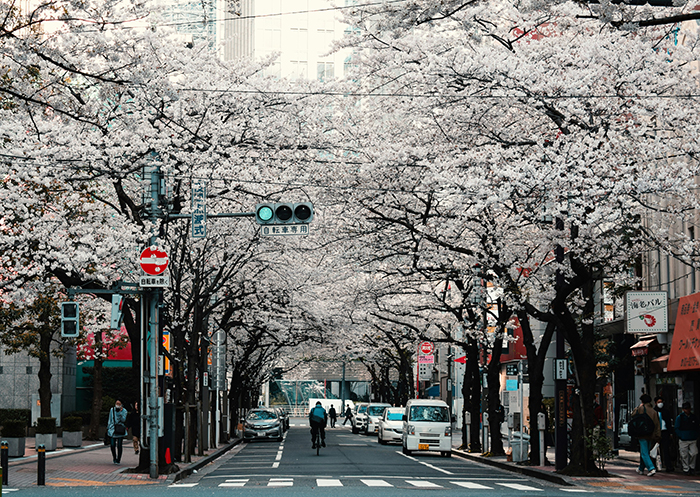
Sakura’s standing in Japanese culture is often traced to 無常 mujo, impermanence. A cherry tree bursts into full bloom and then, at the first strong wind, scatters its petals within days. That fleeting arc — glorious, then gone — reads as a picture of impermanence itself, and the flower’s willingness to fall cleanly rather than linger is part of what people find moving about it.
Long popularity has made sakura a recurring motif: on kimono, on coins (the 100-yen coin among them), and on postage stamps, where special issues built around famous cherry-blossom sites are common.
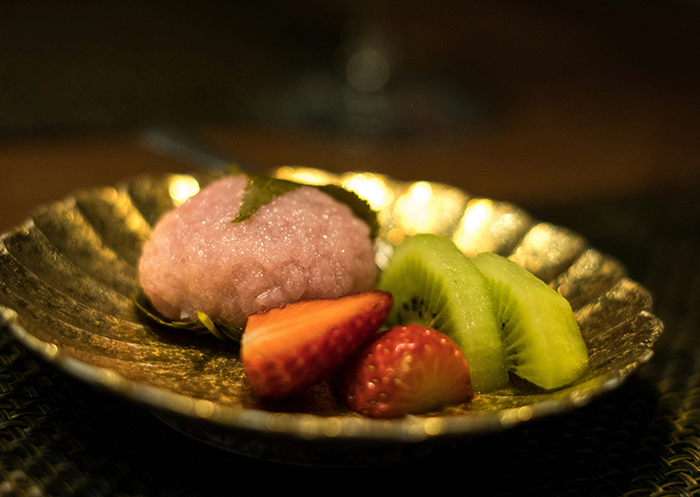
The flower also shows up on the table. The dish most associated with sakura is 桜餅 sakuramochi, a sweet made of red bean paste wrapped in pink dough and a salted cherry leaf. Two regional styles diverge in method: the Kanto style, known as 長命寺 Chomeiji, wraps the filling in a thin, crepe-like dough made from wheat flour and water; the Kansai style, 道明寺 Domyoji, uses 道明寺粉 domyojiko, a coarse flour made from dried, steamed glutinous rice, giving the sweet a grainier, mochi-like texture.
Every spring, restaurants and cafes also roll out sakura-themed menus — lattes, smoothies, and more — nearly always in the same pale pink. The flavor itself traces back to salted blossoms and leaves: salting is said to produce an aromatic compound called coumarin, which brings out sakura’s characteristic scent. Not every salted cherry leaf is meant to be eaten, however, so edibility is worth checking before tasting one.
Ume: The Older Arrival
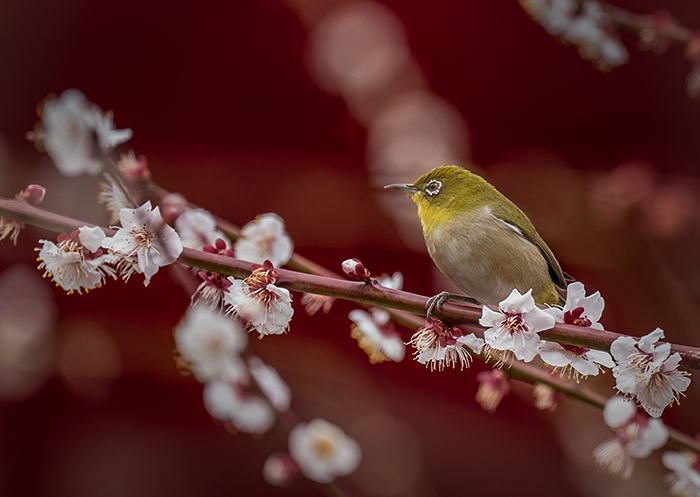
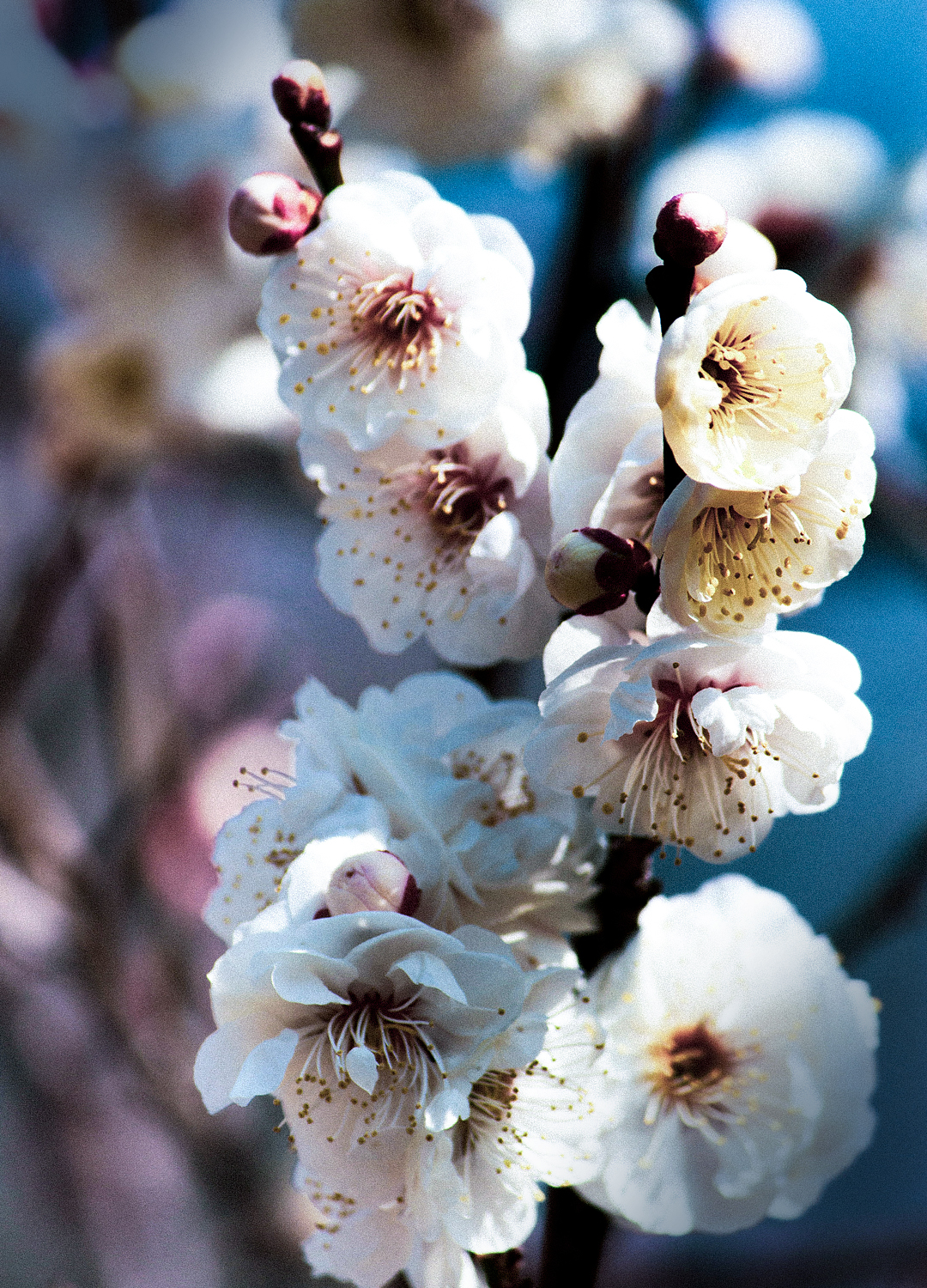
Ume did not originate in Japan. It is native to China and was brought over in the Nara period (710–794) by envoys on the missions to Tang China, 遣唐使 kentoshi — the same missions responsible for carrying back kanji, Buddhism, and continental arts and crafts. That they also carried back a tree is easy to overlook.
For a time, ume, not sakura, was the flower Nara-period aristocrats gathered to admire. The shift toward sakura came later, in the Heian period (794–1185). Even so, ume never disappeared from Japanese life: famous ume groves remain scattered across the country today, and the flower is still treated, alongside sakura, as one of the signals that spring has arrived.
Ume and Sugawara no Michizane
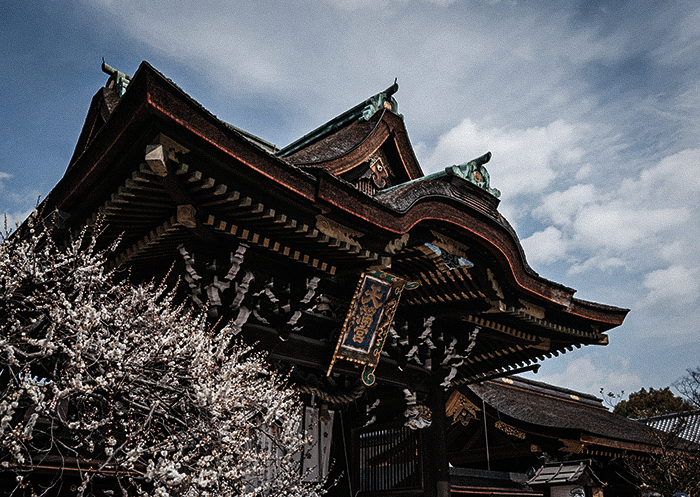
Ume’s story in Japan is bound up with one figure in particular: 菅原道真 Sugawara no Michizane, a scholar and statesman of the Heian court said to have loved the flower above all others. Michizane was the official who ended the missions to Tang China and championed a homegrown, distinctly Japanese court culture — and who was, for his prominence, exiled to Dazaifu in Kyushu after drawing the jealousy of rival nobles.
Leaving the capital, Michizane bid farewell to three trees he had loved: an ume, a sakura, and a pine. To the ume he left a poem:
「東風吹かば にほひをこせよ梅花 主なしとて春を忘るな」
In modern paraphrase: when the east wind blows again, send your fragrance, plum blossom — even with your master gone, do not forget that spring has come.
The trees in his garden are said to have withered from missing their master. Two, however — the ume and the pine — tried to follow him through the air. The pine gave out partway and took root on a hill later named 飛松岡 Tobimatsuoka, “flying-pine hill.” The ume made it all the way, arriving safely at Dazaifu in a single night. This is the 飛梅伝説 Tobiume densetsu, the legend of the flying plum, and the tree is now venerated as the sacred tree of Dazaifu Tenmangu.
Michizane’s story did not end with his exile. After his unfortunate death, misfortune struck the nobles who had driven him out. In 930, lightning struck the 清涼殿 Seiryoden, the emperor’s residence hall, killing several nobles outright — an event remembered as the Seiryoden Lightning Incident. Emperor Daigo himself died three months later. The chain of disasters was widely attributed to Michizane’s vengeful spirit, and the response was to restore his honor and enshrine him at Kitano, a site already associated with the god of thunder and fire. This is one account of the origin of 北野天満宮 Kitano Tenmangu, the shrine in Kyoto built in his name.
Kitano Tenmangu today holds roughly 1,500 ume trees planted in Michizane’s memory. He is now worshipped as the god of scholarship, and students visit in large numbers during school trips to pray for success on entrance exams — this author included, on a middle-school trip made not long before facing high school entrance exams.
Ume on the Table
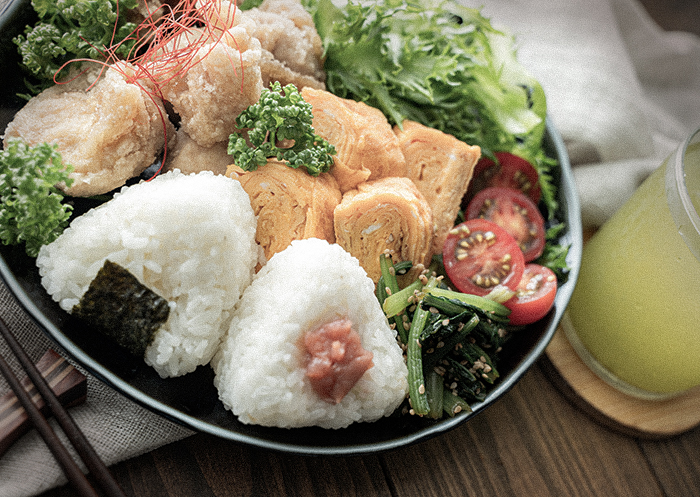
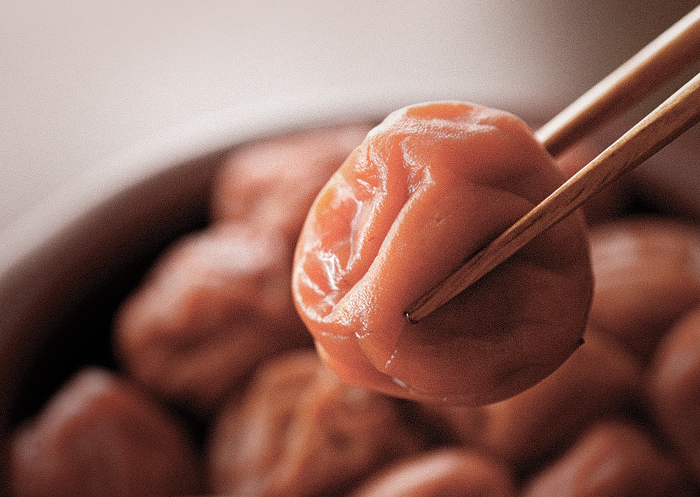
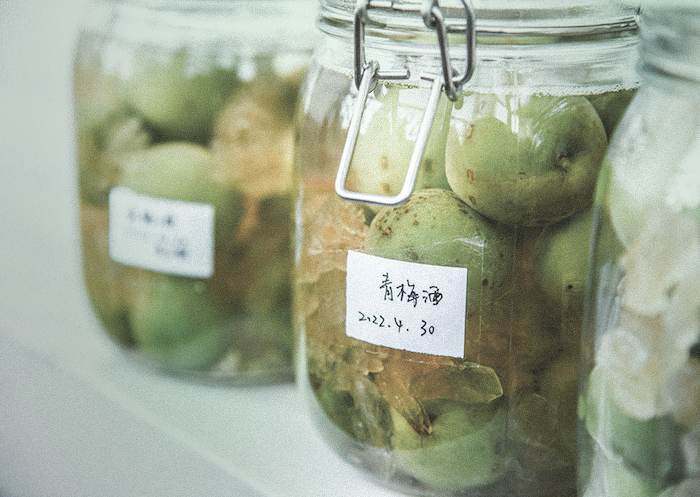
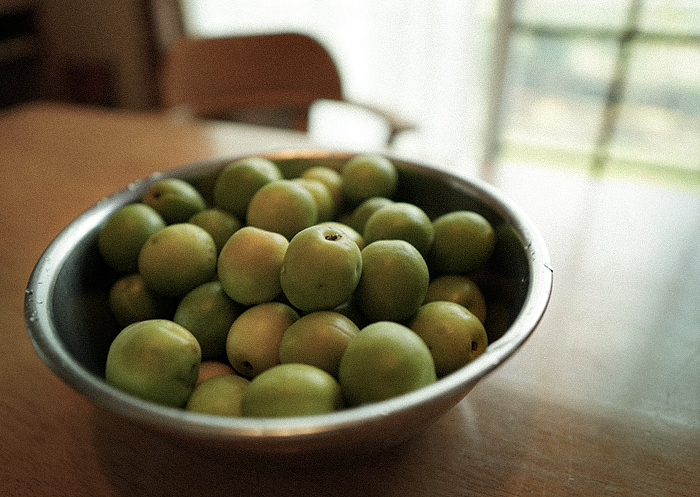
Ume shows up in Japanese cooking far more often than sakura does, largely because of the citric acid it contains, long valued for fighting fatigue — ume was used medicinally before it was ever treated as an ordinary food. A few of its best-known forms:
梅干し Umeboshi — ume salted and then sun-dried, a preserved food used medicinally in the Heian period and carried by soldiers as field rations during the Sengoku period. Today it turns up in rice balls, in ochazuke, and as umeniku, a paste used to season vegetable dishes. Sweetened versions are common in shops now, though this author’s grandmother maintains that old-fashioned umeboshi were, properly, salty rather than sweet.
梅酒 Umeshu — green ume steeped with rock sugar and a distilled spirit, most often 焼酎 shochu, though sake or brandy can also be used. The balance of sugar and alcohol is adjustable, which is much of the appeal of making it at home; it is usually drunk on the rocks or with soda, and its flavor runs light and refreshing. Ready-made bottles are also sold commercially for anyone who would rather skip the steeping.
干し梅 Hoshiume — umeboshi dried further and sweetened with syrup or honey, best understood as a candy made from umeboshi rather than a variation on it. It is common as a inexpensive children’s sweet, generally judged sweeter and more approachable than plain umeboshi, though its salt content is still worth watching.
梅みそ Umemiso — a condiment made by combining miso, sugar, and ume, whether green or already dried into umeboshi. Its mix of tartness, savory depth, and sweetness makes it useful with raw vegetables as well as meat and fish. It is also a practical way to use ume too bruised for umeboshi or umeshu, and once made, keeps refrigerated for months.
These preparations belong to a broader seasonal practice called 梅仕事 umeshigoto, “plum work”: the making of home-preserved ume foods each June, when the fruit comes into season. It is not the name of a single dish so much as a term for the whole activity — turning a fruit that is only briefly in season into something that keeps for the rest of the year, in a way that reflects how closely Japanese food culture has stayed tied to the seasons. Two cautions apply: the trees grown for ume blossoms and those grown for edible ume fruit are different cultivars, and unripe green ume pits contain amygdalin, which is toxic — the pit and stem should always be removed before the fruit is cooked or preserved.
The Colors: Kobai-iro and Sakura-iro
Both flowers gave their names to traditional Japanese colors. 紅梅色 kobai-iro, “crimson plum,” is a vivid, reddish pink; 桜色 sakura-iro, “cherry blossom,” is a much paler pink closer to white.
Sakura-iro carries a curious modern footnote: photographs of cherry blossoms often look more saturated than the real flowers do in person. The reason is what colorists call “memory color” — the color people remember sakura as being tends to run more vivid than the color it actually is, so images are often deliberately deepened to match memory rather than reality, so the picture does not look off.
In the Heian period, kobai also appeared in 襲の色目 kasane no irome, the combinations of layered silk that gave the twelve-layer court robe, the 十二単 junihitoe, its seasonal meaning — a practice covered at greater length in KOTO’s article on Japanese traditional colors. Which combination a woman wore, and when, was read as a mark of her taste and education. 清少納言 Sei Shonagon, author of The Pillow Book, had an opinion on this: she judged the kobai combination, if worn in the third or fourth lunar month, to be すさまじきもの susamajiki mono — an anticlimax, something that kills the mood — her era’s way of calling an outfit tasteless for missing its season. Her bluntness reads as remarkably contemporary.
Reiwa and the Plum Blossom Banquet

Japan has used era names, 元号 gengo, continuously since 大化 Taika in 645, at the start of the Asuka period. Each name is chosen to carry a wish, or a political intention, for the years ahead — the previous era, Heisei, was named for a hope that peace would be achieved both at home and abroad, and that a new era might open in that spirit.
Every era name up through Heisei was drawn from Chinese classical texts. Reiwa, adopted in 2019, broke that pattern for the first time, drawing instead on 万葉集 Manyoshu, Japan’s oldest surviving anthology of native poetry. Its source is a set of 32 waka composed on the theme of plum blossoms at a gathering remembered as 梅花の宴 Baika no En, the Plum Blossom Banquet, recorded in the anthology’s fifth volume.
Reiwa was chosen with the hope that culture might grow from people drawing their hearts beautifully together — and the decision to look, for the first time, to a Japanese rather than a Chinese classical source is worth sitting with. The Manyoshu records the culture and daily life of ancient Japan in a way no borrowed text could. It was adopted, too, in the years just after Japan saw a sharp rise in foreign visitors, sometimes called the inbound boom — a moment, perhaps, when looking again at Japan’s own traditional culture had become worth doing.
Two Flowers, One Season

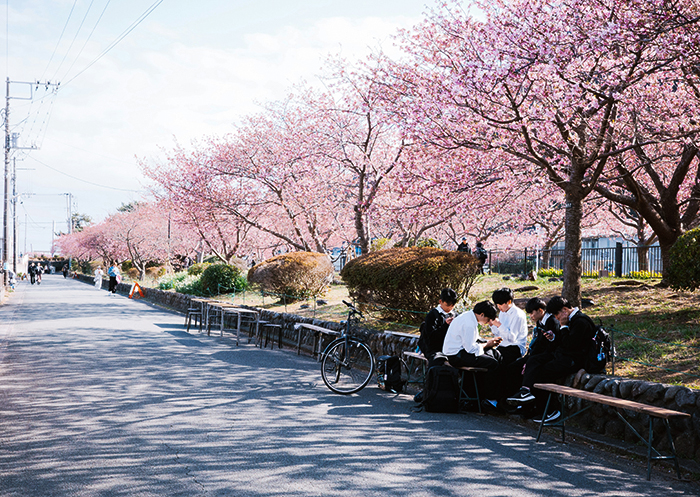
Why hanami itself moved from ume to sakura in the Heian period is its own story, tied to the end of the missions to Tang China and the rise of a homegrown court culture — KOTO’s article on the history of hanami covers that shift in full. What stands out from the two flowers’ separate histories is how differently each one earned its place: ume arrived as an import, prized for a fragrance and a foreign origin that dazzled the Nara court, while sakura had been in Japan all along, once treated as too sacred, as a dwelling place of the gods, to be casually admired. Both changed status over the centuries that followed — sakura climbing to become the flower most identified with Japan itself, ume settling into an association with scholarship, remembrance, and the kitchen.
Between them, they cover nearly three months of the Japanese year, from January to April, without much overlap — a plum, then a cherry, each announcing spring in its turn.
KOTO is a journal of Japanese craftsmanship, culture, and the aesthetic sense behind them.
- SHARE
-


( landscape )