





Kanto vs. Kansai: The Food Differences Between East and West Japan
Japanese food travels abroad under a single reputation: healthy, balanced, built on the natural flavor of good ingredients. Within Japan itself, though, that food is not one thing. Cross the country from east to west and the meat changes, the broth changes color, and even the word for a rice ball changes. This article sets out what separates 東日本 Higashi Nihon, eastern Japan, from 西日本 Nishi Nihon, western Japan, at the table — and a little beyond it.
What Counts as Eastern and Western Japan
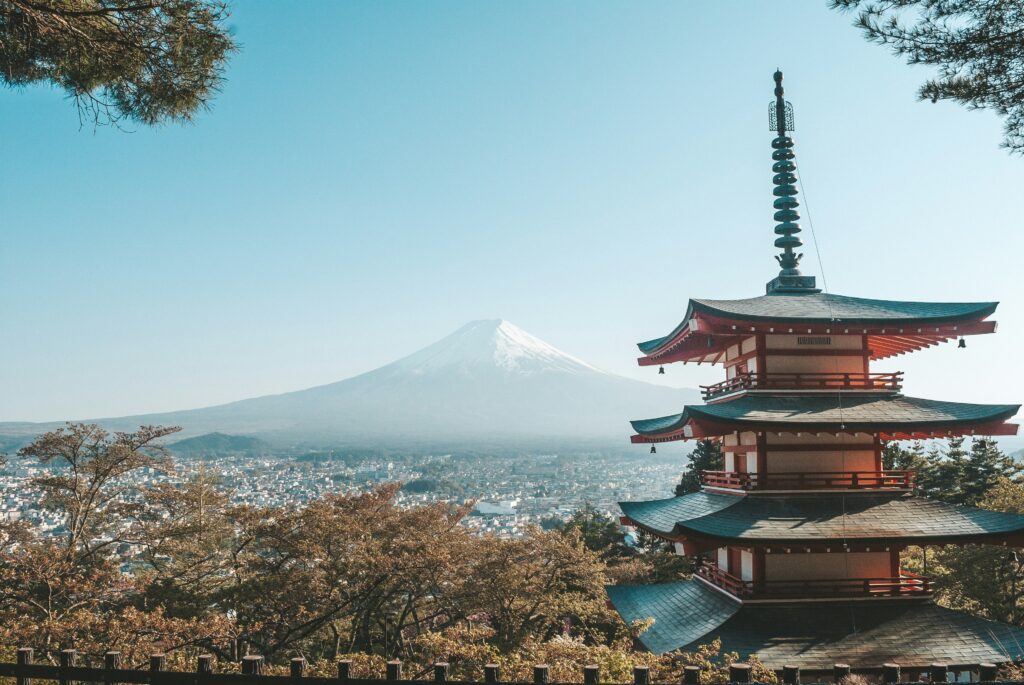
The Japanese archipelago is commonly split in two: the eastern half is Higashi Nihon, the western half Nishi Nihon. There is no single official boundary, but a few different lines are used depending on the context.
Eastern Japan — Western Japan
|—|—|—|
Geography / administration — Hokkaido, Tohoku, Kanto — Kinki, Chugoku, Shikoku, Kyushu
NTT landline boundary — Hokkaido, Tohoku, Kanto, plus Yamanashi, Niigata, Nagano — Kinki, Chugoku, Shikoku, Kyushu, plus Toyama, Gifu, Aichi, Shizuoka, Ishikawa, Fukui
Geology (either side of the Fossa Magna) — East of the line — West of the line
Representative cities — Sapporo (Hokkaido), Sendai (Miyagi), the 23 wards of Tokyo — Kyoto, Osaka, Hakata (Fukuoka)
The Chubu region, in the middle of the country, is assigned to one side or the other depending on the measure used. The geological line referenced above is the フォッサマグナ Fossa Magna, a great rift that runs through central Japan and marks where the Japanese archipelago was pulled apart in its geological past.
Two shorthand names are worth knowing alongside these: Kanto, the Tokyo region, and Kansai, the Kyoto-Osaka region. They are narrower than “eastern Japan” and “western Japan” — Kanto is one part of the eastern side, Kansai one part of the western side — but in everyday conversation, and in most of the food customs below, “Kanto vs. Kansai” and “east vs. west” are treated as roughly interchangeable.
Where Japanese Food Culture Splits East and West
The Meat of Choice: Pork in the East, Beef in the West
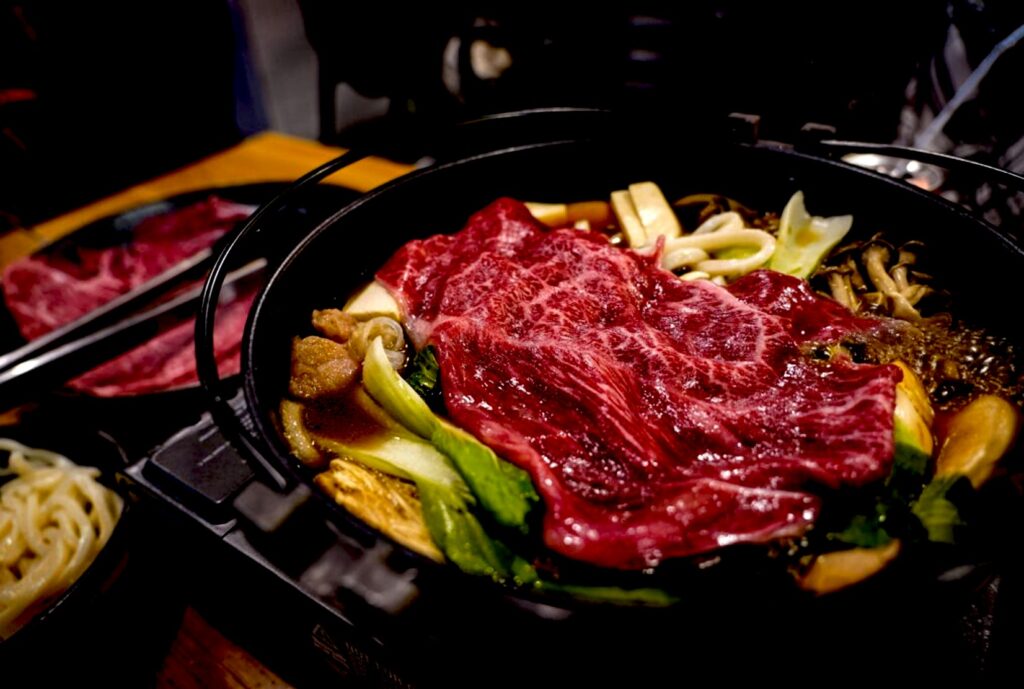
Eating meat became widespread in Japan only in the Meiji era (1868–1912), and beef dishes were what spread first. Later, as social conditions made beef harder to come by, western Japan is said to have turned to eating the cattle that had been kept for farm labor.
Eastern Japan had relied on horses rather than cattle for farm work, and a horse yields far less usable meat. Pork appears to have filled the gap instead — and pork has remained the everyday meat of the east ever since, set against a western Japan that still reaches for beef.
Seasoning and Dashi
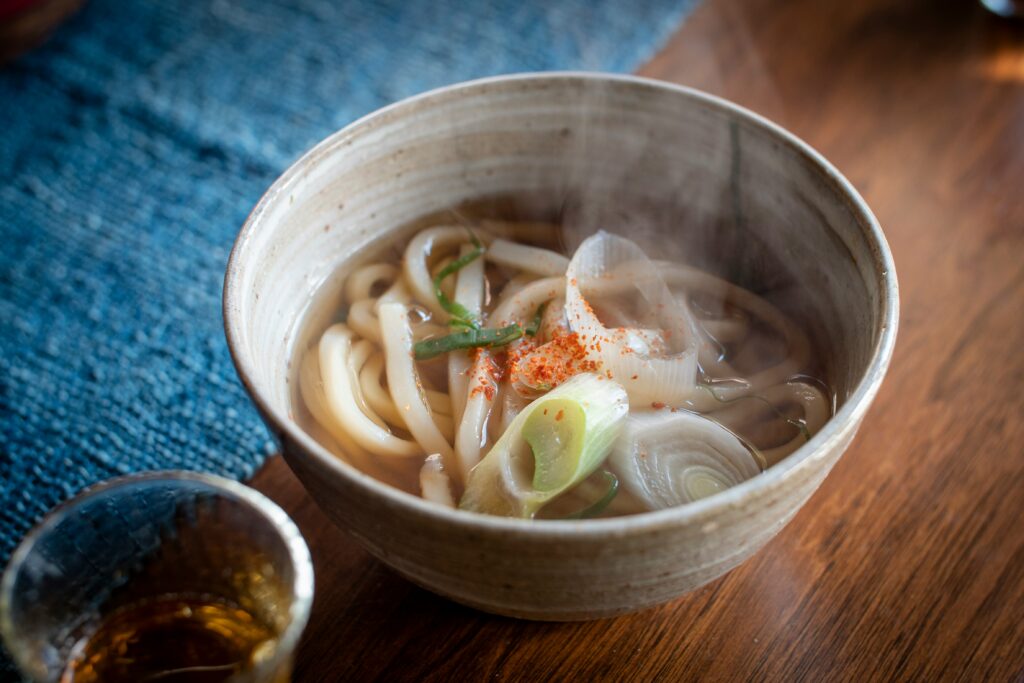
Eastern Japan seasons with かえし kaeshi — a mix of dark soy sauce, sugar, and mirin — built on a bonito-based dashi. Western Japan reaches for うすくち醤油 usukuchi shoyu, a light-colored soy sauce, over a dashi made from kelp or dried sardines.
Dashi does more than season a dish. It is close to an identity — the taste of the household someone grew up in. Two small stories make the point.
The color of udon broth. This author went to Kyoto on a school trip in junior high and was startled to find the udon broth there completely clear. Back home, in eastern Japan, udon broth was a deep brown. A local taxi driver, noticing the hesitation, urged this author to drink the broth too — “the dashi is what makes it” — and the first cautious sip revealed a flavor at once complex and gentle, an impression that has stayed with this author since.
The seasoning of tamagoyaki. Rolled omelette, 卵焼き tamagoyaki, is a fixture of the Japanese bento box, and its seasoning varies sharply by region and household. This author’s family made it sweet, built on sugar. A university classmate from western Japan heard this and pushed back: tamagoyaki, done properly, should carry the saltiness of dashi and soy sauce. The two spent an occasional evening arguing over whose version was better. These days, this author’s own kitchen has settled on a compromise — 白だし shiro-dashi, a light dashi-based seasoning, diluted with water and rounded out with a little sugar.
What to Call a Rice Ball
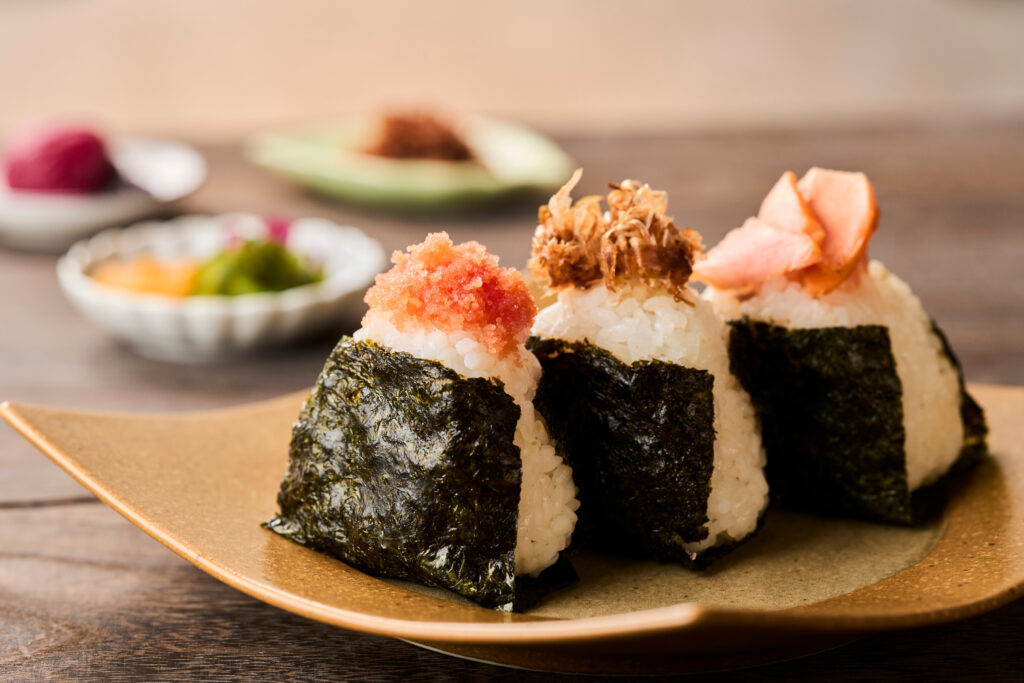
Eastern Japan says おにぎり onigiri. Western Japan says おむすび omusubi.
The pressed rice ball is one of Japan’s oldest foods, and its two names are said to have separate origins.
Onigiri, in the eastern telling, comes from 握り飯 nigirimeshi — “hand-pressed rice” — which is said to have shifted toward 鬼切り oni-kiri, “demon-cutting,” carrying a wish for protection from evil.
Omusubi, sometimes written 御結び, traces to several different stories: to a god named in the 古事記 Kojiki, Japan’s oldest chronicle, compiled in 712; to the idea of “tying,” musubu, a good match or good fortune; or to 女房言葉 nyobo kotoba, a vocabulary once used by court ladies. Several theories exist, and naming also varies by region.
In practice, the difference has nearly disappeared today. The Onigiri Association, a Japanese industry body organized around the food, holds that any remaining difference between “onigiri” and “omusubi” comes down to individual households and personal habit rather than geography.
The shape varies too — beyond the familiar triangle, some regions make theirs round, or shaped like a short cylinder. This author once asked, while traveling in a region that shapes them round, why that particular form was chosen, and was told it carries a wish for relationships without sharp corners — smoother, more harmonious dealings between people. A wish that no one quarrel, that everyone get along: it is there, quietly, in the food itself. The rice ball this author ate afterward tasted a little gentler for knowing it.
The Mochi in New Year’s Zoni
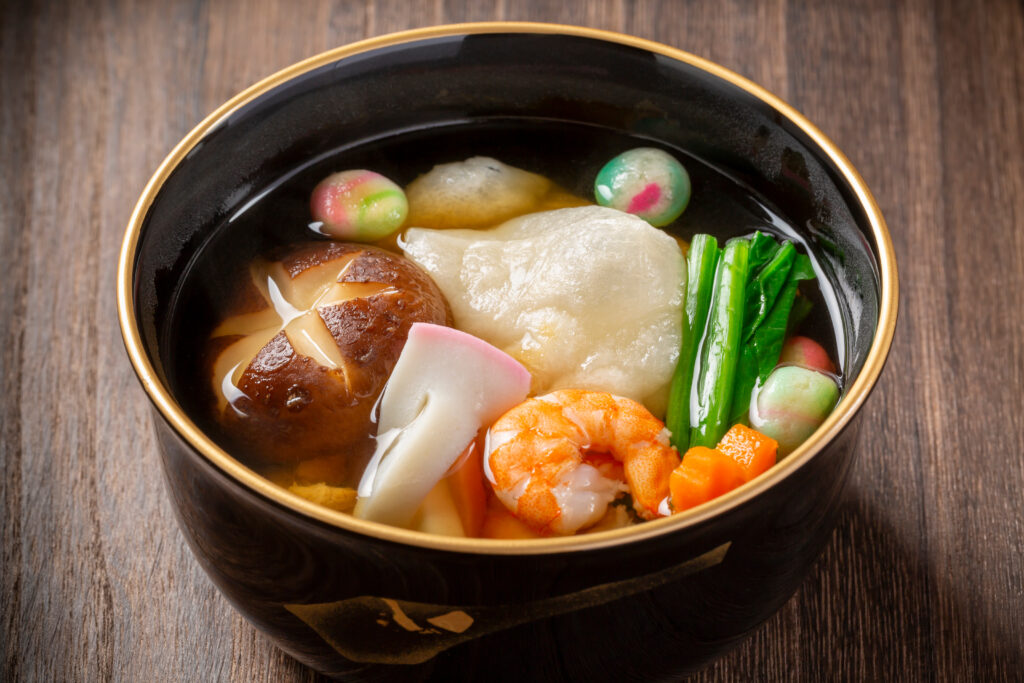
Eastern Japan cuts its mochi into squares, 角餅 kakumochi, for お雑煮 ozoni, the soup eaten every New Year’s Day from January 1st onward. Western Japan shapes its mochi round instead, 丸餅 marumochi. The dashi used in ozoni is also said to differ between the two regions.
Beyond the Table: A Few More East-West Differences
Food is not the only place eastern and western Japan diverge. A few more differences, briefly:
Electrical frequency. Eastern Japan runs on 50 hertz, western Japan on 60. This author once moved from east to west and discovered, the hard way, that appliances brought along from home simply would not run — the frequency mismatch again.
Manner of speech. Eastern Japan leans toward polite, formal speech; western Japan tends toward a more frank, direct style. These are tendencies rather than rules, and the sensible approach while traveling is to read the room and adjust. The same chain restaurants are sometimes known by different abbreviated nicknames in the east and the west, for what it’s worth.
Which side to stand on an escalator. Japanese etiquette calls for leaving one side of an escalator clear for people in a hurry — the right side in eastern Japan, the left in the west. Travelers moving between the two sometimes hesitate over which side to take; the safest rule is to follow whichever way the people around you are already moving. As the Japanese saying goes, 郷に入れば郷に従え go ni ireba go ni shitagae — enter a village, follow its customs — the local equivalent of “when in Rome.”
In Closing: One Country, More Than One Way of Eating
Even within a single country, eastern and western Japan have grown distinct habits at the table and beyond it. Distribution networks and easier travel have narrowed many of these differences in recent years.
Even so, looking closely at what a region eats, and why, opens a window onto the practical wisdom and quiet hopes that earlier generations built into daily life. Anyone with the chance to travel between eastern and western Japan might enjoy going looking for these differences firsthand.
KOTO is a journal of Japanese craftsmanship, culture, and the aesthetic sense behind them.
- SHARE
-


( food )