









Hagakure: The Book Behind “The Way of the Samurai Is Found in Death”
武士道と云ふは死ぬ事と見付けたり — Bushido to iu wa shinu koto to mitsuketari. It means “The Way of the 侍Samurai is found in death.” It is famous words written in 葉隠 Hagakure, a foundational guide for Samurai.
This line has traveled further than the book that contains it. But most people who can quote it have never read the work it comes from, and a good number of them have the meaning backwards.
Hagakure is stranger and gentler than its reputation. It was not written by a samurai on campaign, but dictated by a retired retainer who had been dismissed from service, spent years studying Buddhism.
The auther was by his own account, fond of being alive.
This article sets out what Hagakure is, where it came from, what it actually teaches, and why the line about death does not mean what it appears to mean.
What Hagakure Is
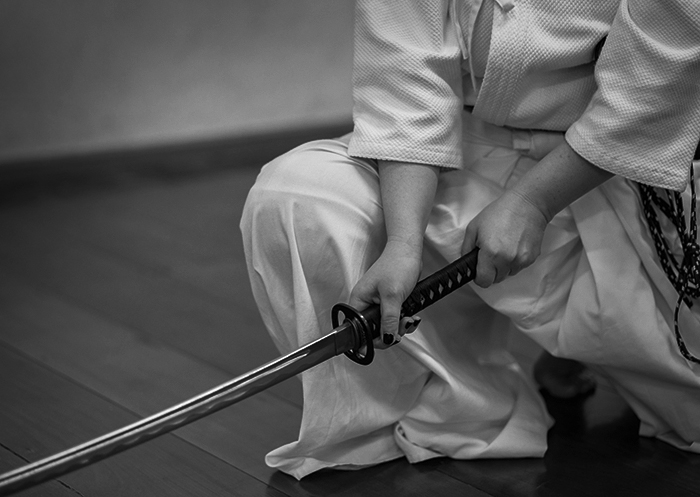
Hagakure is a work in eleven volumes, compiled in the middle of the Edo period (1603–1868), setting down the bearing and the conduct expected of a samurai. Its central argument is that a retainer should strip away private interest and personal appetite, and serve his lord with a loyalty so complete that he holds his own life lightly.
It is said to have been in existence by 1716.
Introductuion about two authors
Hagakure has two names attached to it, and only one of them did the writing.
The words are those of 山本常朝 Yamamoto Tsunetomo. They were taken down by 田代陣基 Tashiro Tsuramoto, who sat with him and recorded what he said. The book is therefore a transcript of speech rather than a composed treatise, which accounts for its texture — it circles, repeats, and digresses in the way that talk does.
Both men belonged to the 佐賀鍋島藩 Saga Nabeshima domain, in what is now Saga Prefecture in northern Kyushu.
That detail is worth pausing on. Saga was not a backwater. It became known for the 弘道館 Kodokan, its domain academy, and for adopting Western medicine and Western military technology earlier than most of Japan. At the Meiji Restoration it stood among the 薩長土肥 Satchodohi — the four domains that did most to bring down the shogunate and build the new government, corresponding to present-day 鹿児島県 Kagoshima prefecture, 山口県 Yamaguchi prefecture, 高知県 Kochi prefecture and 佐賀県 Saga prefecture.
A domain that invested that heavily in learning was a domain in which a book like this could be made.
The Man Behind the Voice
What gives Hagakure its particular character is that its account of loyalty is suffused with compassion rather than ferocity. That is difficult to explain from the text alone. It is easier to explain from Yamamoto’s twenties.
He served 鍋島光茂 Nabeshima Mitsushige, the lord of the domain, as a 小姓 kosho — a page in personal attendance. Then he made a mistake. While in Mitsushige’s service he spent time composing poetry with the lord’s son, 鍋島綱茂 Nabeshima Tsunashige, and this displeased his master. He was ordered to withdraw from his duties.
Dismissed and out of favor, he turned to the study of Buddhism.
During those years he went repeatedly to 石田一鼎 Ishida Ittei, reckoned the foremost scholar in the domain, a man versed in 神道 Shinto, Buddhism and Confucianism alike, and came away marked by him.
The Hagakure we have is the work of a man who had been humbled, had studied under a teacher, and had time to think. That is not the biography one expects behind a book about dying well, and it is the reason the book has lasted.
The Ideas at the Center
Hagakure ranges widely, but two words recur until they organize everything else: 忠義 chugi, loyalty, and 慈悲 jihi, compassion.
Loyalty Expressed as Action, Not Deliberation
The first teaching is service in which private interest has been set aside — 活私奉公 kasshi hoko, putting the self to use in service to lord and country.
The emphasis falls on sequence. Hagakure holds that loyalty is demonstrated by acting before one has finished reasoning about it, not by arriving at the correct conclusion and then acting. The ideal is 不言実行 fugen jikko, doing without announcing, carried out in a state of complete absorption that the book calls the ground of death — a condition in which calculation about one’s own position has simply stopped.
Hidden Virtue, and Compassion Without Exception
The second teaching concerns what you do with your good conduct once you have performed it.
Accumulating good acts is elementary. Drawing attention to them is not permitted. What Hagakure asks for is 陰徳 intoku — hidden virtue, good done where no one can see it, from a position deliberately kept in the background.
Alongside it stands compassion extended to everyone without distinction. Combined with loyalty and with 孝行 koko, filial duty toward one’s parents, these form what is known as the 四誓願 shiseigan, the four vows.
The practical shape of this is worth noting, because it is not what “samurai code” usually calls to mind. Yamamoto asks for attention paid to colleagues in the same service and to those younger than oneself — for serving the lord in a manner that encourages the people serving alongside you.
The Line About Death
Now the sentence everyone knows.
武士道と云ふは死ぬ事と見付けたり — The Way of the Samurai is found in death.
What it teaches is that by settling one’s account with death in advance, a person becomes able to decide and act in accordance with conscience. Holding death in view during ordinary life is what makes it possible to live the present moment at full strength.
Why It Is Not an Argument for Dying
Read alone, the line invites an obvious conclusion: that Bushido recommends throwing one’s life away. Period drama reinforces it, since scenes of self-inflicted death recur through any depiction of the Sengoku and Edo eras.
Yamamoto is not recommending death. His intent runs along four lines:
– Acting as though one’s life were already spent produces the highest performance one is capable of.
– The self-sacrifice at issue is the surrender of one’s own will, not of one’s body.
– Keeping death continually in mind is what preserves a sense of the preciousness of life and of consideration for the people around you.
– When forced to choose between two courses, take the harder one without hesitating.
There is also his own testimony. Yamamoto stated plainly that he was fond of living. Whatever the book is doing, it is not glorifying death.
Where the Title Comes From

葉隠 Hagakure is a word about foliage, and appears at first to have nothing to do with warriors. The name carries its author’s intention.
It means to lie hidden beneath the leaves.
The reader — a samurai — is to live without standing on the visible stage, and to hold to the principles of Bushido regardless.
The timing explains the emphasis. A samurai exists, in principle, to serve his lord or his country by force of arms. But by the time Hagakure was set down, roughly a century had passed since the 大坂夏の陣 Osaka Natsu no Jin, the summer campaign of 1615 that ended the age of open warfare. The occasion for a samurai’s defining function — to fight, and to protect his lord in the fighting — had all but disappeared.
The title holds the wish that the ideal should be carried forward anyway, by men who would never be called upon to demonstrate it.
There is a second reading, which is that Hagakure was never meant for a general audience at all. By one estimate, samurai made up around seven percent of the population when it was written. A book addressed to that seven percent was not written with wide circulation in mind.
The two readings agree more than they disagree. Yamamoto held that parading one’s own achievements was beneath a samurai. A book named for what lies concealed under leaves is consistent with the man who said so.
What It Became
Hagakure concerns itself with samurai, a class that no longer exists. Its afterlife has been considerable.
Mishima Yukio
三島由紀夫 Mishima Yukio, among the defining figures of postwar Japanese literature and a candidate for the Nobel Prize, was profoundly affected by it. He recorded that he returned to Hagakure again and again as a book he loved.
In 1967 he published 葉隠入門 Hagakure Nyumon, translated into English as The Way of the Samurai.
The book is, in effect, Mishima making the case for Hagakure — but it is not only commentary. Through it one sees Mishima’s own philosophy of life, his morality, and his view of death. For a reader interested in what Bushido looked like to a modern Japanese writer of the first rank, it is a rare document.
A Manual for Working Life

The material on absolute loyalty to a lord found a second career in business training, where it is most often invoked to explain the bearing a person should bring to working life.
The translation is direct enough. Serve the company, which occupies the position of the lord, with wholehearted sincerity. Extend a hand to colleagues and juniors, and do it from compassion rather than obligation.
Whether that mapping is faithful to Yamamoto is a fair question. That the mapping has been made at all is a fact about how the book is read today.
What Remains
In Hagakure Nyumon, Mishima described the relationship between the Japanese and the question of life and death as rooted in daily life as a single principle with two faces. He treated it as something like a stream running through the ordinary world, and as a source of Japanese art. After the book appeared, critics found in it a concentration of the dignity of being alive.
Hold to compassion toward others. Then live this moment with everything you have.
Those propositions do not belong to a particular century. They are what survives when the armor is removed.
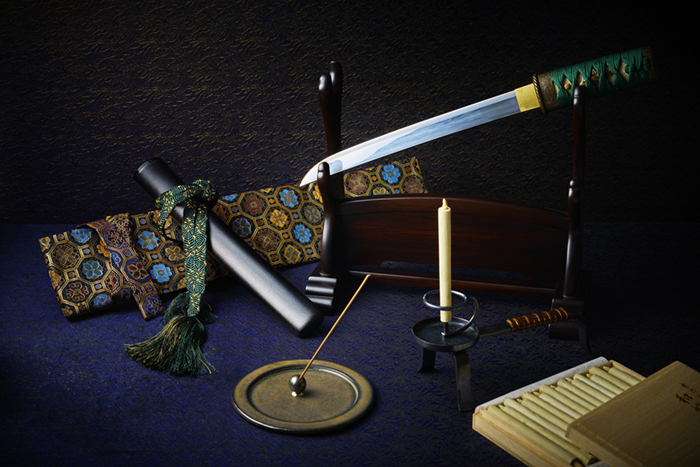
KOTO offers pieces made for those who wish to keep the samurai’s discipline within reach — a Japanese sword and a hand-made candle, produced to order by craftsmen working in traditions two thousand years old. Because each is made individually, no two are ever the same.
- SHARE
-


( tales )