







Arita Ware: The Three Styles Behind 400 Years of Japan’s First Porcelain
Tradition, it is said, is something alive and in motion — carrying an essence that never changes, yet never standing still for even a moment. What remains, without anyone having set out to preserve it, is called tradition.
有田焼 Arita-yaki, Arita ware, has continued for some 400 years — from a difficult beginning, through an age when it reached overseas, through the Edo period (1603–1868) when it was part of everyday Japanese life, through an era of adapting to Western taste, and into the present and what comes next. This article introduces Arita ware as it stands today, alongside the three styles that have defined it.
Arita ware took shape out of three technical lineages at once: the porcelain-firing techniques brought over from Korea, techniques from China, and the skill of Japan’s own potters.
The Three Styles That Defined Arita Ware
Arita ware is known for three representative styles of decoration: 古伊万里様式 Ko-Imari style, 柿右衛門様式 Kakiemon style, and 鍋島様式 Nabeshima style. In the early years of Arita ware — the Ko-Imari period, in the Edo period — potters looked up to the polychrome ware imported from 景徳鎮 Jingdezhen, the great kiln town in China, and much of the underglaze blue-and-white ware made at the time followed the Chinese model closely.
Distinctly Japanese refinements followed over time, gradually raising the level of the work, until the Kakiemon and Nabeshima styles reached their finished form.
古伊万里様式 Ko-Imari Style

Ko-Imari style pairs a deep underglaze blue with the lavish use of red and gold enamels known as 金襴手 kinrande, “brocade” ware. Pieces built on a dense blue-and-white ground carry a generous overlay of red and gold enamel, and some are finished with gold powder or gold paint worked over the polychrome design for further richness. The style reflects the opulence of the Genroku era (1688–1704) that produced it, with motifs of plants, animals, geometric patterns, and karakusa scrollwork.
The name comes not from Arita itself but from 伊万里 Imari, the neighboring port from which the ware was shipped out to the rest of Japan and abroad — which is also why, historically, this porcelain became known in the West simply as Imari ware.
柿右衛門様式 Kakiemon Style
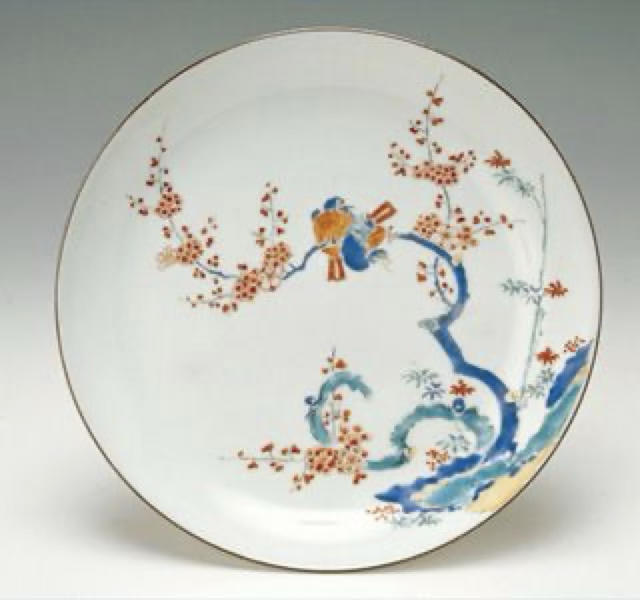
Kakiemon style is defined by red enamel painting set against a milky-white body. Its signature ground is 濁手 nigoshide, a milky-white porcelain body prized for its clean, warm tone. Against it, painters left generous empty space and rendered birds, flowers, and the beauty of the four seasons in fine black outlines filled in with red, green, yellow, and blue, and the compositions are typically symmetrical.
Where earlier ware had rendered Japan’s flowers, birds, and landscapes in a narrower palette, Kakiemon painters worked in red, blue, yellow, and green, set the design symmetrically, and returned again and again to a repertoire of recurring motifs — maple leaves and deer among them. Kakiemon porcelain, made with the European market in mind, became one of the vehicles that carried ジャポニズム Japonisme — the West’s taste for Japanese art and design — outward into the world.
鍋島様式 Nabeshima Style

Nabeshima style was produced at a 御用窯 goyogama, an official kiln run directly by the Nabeshima domain, and made specifically as gifts to be presented upward rather than sold. Built on a milky-white body that makes generous use of empty space, Nabeshima ware has a faintly blue-tinged surface, a design painted on the reverse of the piece as well as the front, and a distinctive comb-carved foot ring known as くし高台 kushi-kodai. Because it was made through the Edo period as a formal gift to the Tokugawa shogunate and to other daimyo lords, its beauty carries the restraint and formality proper to something made to be presented, not sold.
Arita Ware Today


Those are the three styles that have defined Arita ware. For many people, “Arita ware” still calls up an image of splendid, elaborate enamel painting in a distinctly Japanese idiom — this author included. So how is Arita ware evolving today? We close with 渓山窯 Keizangama, a kiln that makes tableware meant to sit close to everyday cooking and everyday meals.
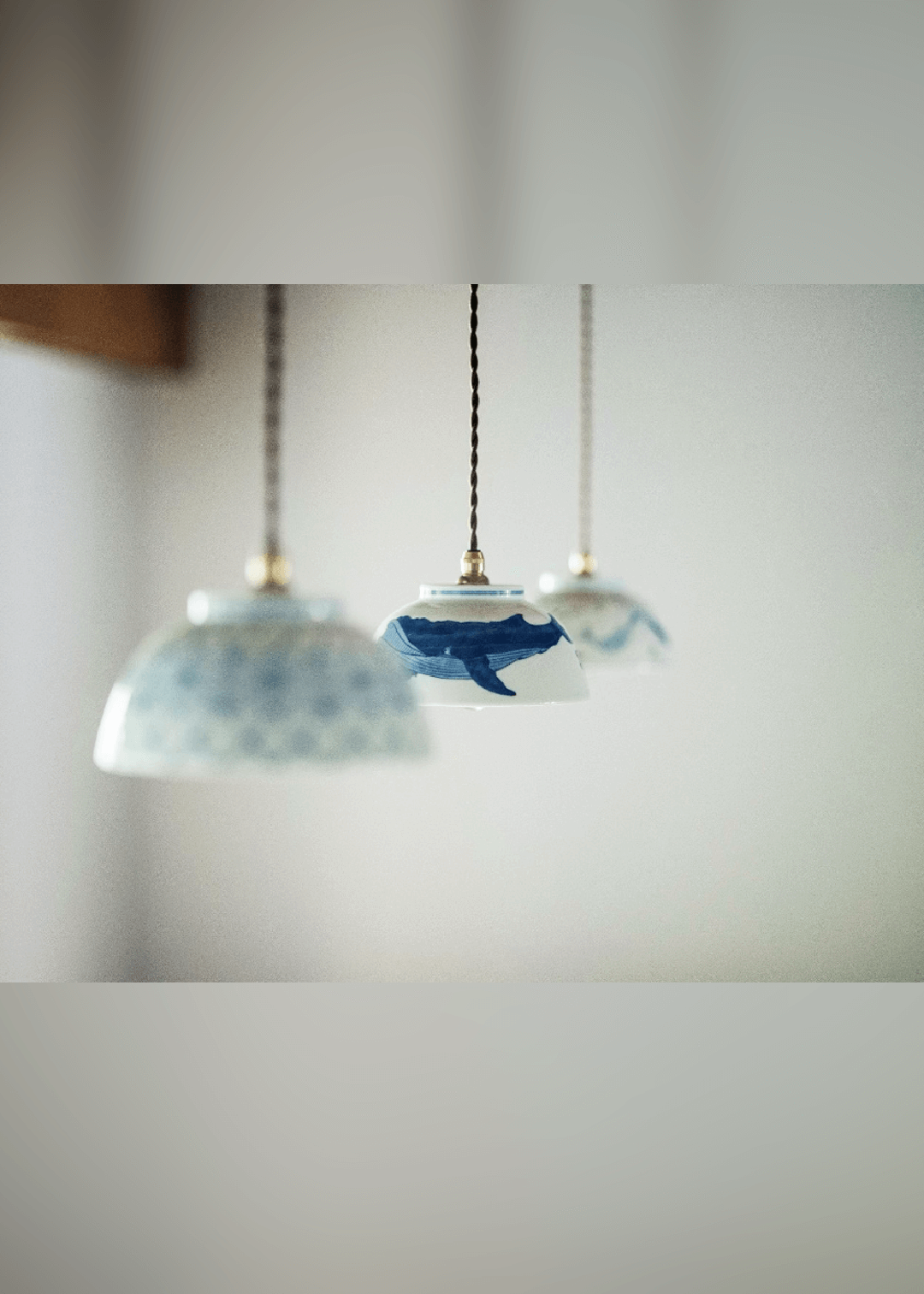
A table becomes richer simply for having a piece like this on it. Using it is, in itself, a pleasure. We wanted to make our own original Arita ware, with our own hands, and put it directly into people’s hands — that is the spirit behind Keizangama’s work, and the ware it produces is made to sit comfortably inside a contemporary life. Its painted motifs draw on the old, familiar patterns of Arita ware, filtered through the artisan’s own sensibility and a contemporary touch. A whale drifting unhurried across white porcelain, painted by hand piece by piece — the designs carry humor and warmth. In one piece, a sake vessel has been repurposed as a flower vase; once a design feels at home in daily life, it is no longer bound to a single use.
To let people feel richness inside their everyday life, while the essence itself remains unchanged and simply continues to exist in its own time — that is the shape Arita ware’s 400-year history continues to take. It will go on existing close at hand, as ordinary and as constant as the air.
KOTO is a journal of Japanese craftsmanship, culture, and the aesthetic sense behind them.
- SHARE
-


( craft )