



Japanese Onomatopoeia by Season: The Words for Sound, Weather, and Feeling
Japanese is known as a language that makes delicate distinctions between subtle nuances. A frequently cited reason for this is the vast array of オノマトペ onomatopoeia, the words representing sounds or states.
Onomatopoeia often take the form of a repeated two-syllable word. They can be broadly divided into two groups. One group consists of 擬音語 gion-go, which mimic actual sounds; the other consists of 擬態語 gitai-go, which describe states or appearances regardless of whether a sound is involved.
Our focus here rests on two specific onomatopoeic words.
「ザアザアと雨がたくさん降ってきた。」
“The rain came down hard, zaa–zaa.”
– “Zaa zaa” means “the sound of heavy rain.”
「ご飯をもりもり食べられて嬉しい。」
“I’m glad to eating meal, mori–mori.”
– “Mori mori” explains “someone eating a large amount of food vigorously.”
This author reaches for them too, without thinking about it, the way most Japanese speakers do. Calling it a culture unto itself is not an exaggeration.
This article gathers the onomatopoeia that render Japan’s four seasons, one season at a time.
What Makes Japanese Onomatopoeia Distinctive

Japanese carries a notably larger onomatopoeia vocabulary than most of the world’s major languages. A few explanations are usually offered for why.
One: A Life Lived in Harmony with Nature and the Seasons
One explanation ties the vocabulary to how Japanese life has long been organized — around nature, and around noticing even a small shift from one season to the next, then turning that noticing into literature.
枕草子 Makura no Soshi, The Pillow Book, the Heian-era (794–1185) essay collection written by 清少納言 Sei Shonagon, one of the court lady objects sharply to clothing that evokes plum blossoms in the middle of summer. The season was wrong, and wrongness of that kind mattered to her. Harmony with the season was something to get right.
As an aside, The Pillow Book also records grievances that read as entirely current. Its Section 25, にくきもの Nikuki-mono “Hateful Things”, complains about mosquitoes whining through the night — a reminder of how little that particular irritation has changed in a thousand years.
Two: Few Verbs Finely Divided by Meaning
A second explanation points to the verb system. Japanese has comparatively few verbs split finely by shade of meaning, and onomatopoeia are said to have developed partly to fill that gap.
English offers a useful comparison within a single family of words:
– look — to direct one’s gaze somewhere, deliberately
– see — to perceive visually, without particular intent
– watch — to follow something in motion, with attention
Where English divides the verb itself, Japanese often reaches for an onomatopoeia to carry the same distinction instead.
Three: A Language Built on Sound and Rhythm
A third explanation is that Japanese grammar and literature have always placed weight on sound and rhythm. Even the same rain sounds different depending on how hard it falls:
– しとしと shito–shito — rain falling quietly, without much force
– ざあざあ zaa–zaa — rain falling hard, with an audibly large sound
Because this kind of sound-and-rhythm distinction reads instantly in children’s books, manga, anime, and social media captions alike, it is a reasonable guess that this is part of why the vocabulary kept expanding.
How Japanese Compares to Other Languages
For reference, here is roughly how many onomatopoeia each language is said to have:
– Japanese: approximately 4,500
– English: approximately 1,500
– French: approximately 600
– Korean: approximately 8,000
Korean has the largest count in the world. The usual explanation is that, beyond differences of nuance, Korean onomatopoeia also vary by the age and gender of the speaker, which multiplies the total.
Japanese, by contrast, tends to use one word across ages and genders, which is one likely reason its count runs lower than Korean’s. ごろごろ gorogoro is a good example of how much work a single Japanese word is asked to do: it covers the rumble of thunder, the state of lying around lazily doing nothing, and the grittiness of something in the eye, or a stomach growling — all with the same four syllables.
Onomatopoeia for Every Season
Spring
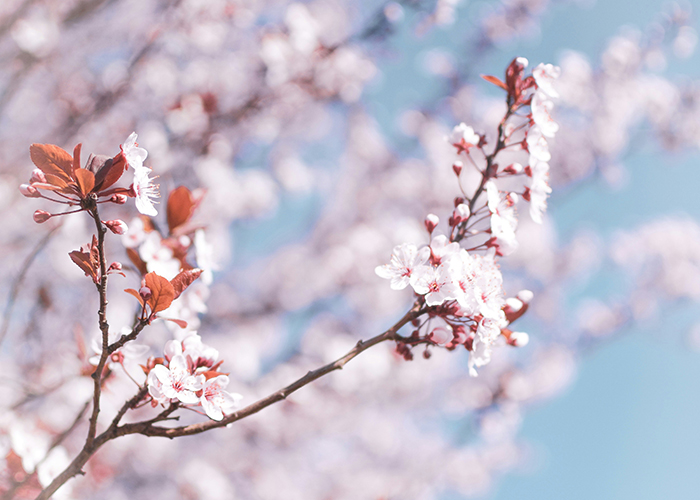
ぽかぽか poka–poka — mild, gentle warmth
The particular warmth of sunlight once the temperature has turned mild and pleasant. It describes the best possible weather for お花見 ohanami, cherry blossom viewing.
Example:
今日はぽかぽかしている陽気で、とても気持ちが良いね。
(“It’s so poka-poka out today, it feels wonderful.”)
ひらひら hira-hira — light, fluttering movement
Butterflies, or flower petals, dancing lightly on the wind. A close relative, ひらりひらり hirari-hirari, appears in “アゲハ蝶 Agehachō” (“Swallowtail Butterfly”), a well-known song by the Japanese rock band Porno Graffitti.
Example:
ひらひらと桜の花びらが手のひらに舞い降りてきた。
(“The cherry petals fluttered down, one by one, hira–hira, onto my open palm.”)
にょきにょき nyoki–nyoki — shooting straight upward
Grasses, trees, or bamboo shoots breaking through the soil and reaching for the sky. The word describes the scene in Studio Ghibli’s “となりのトトロ My Neighbor Totoro“ (1988) where planted seeds sprout and shoot upward overnight. It also gives its name to たけのこニョッキ Takenoko Nyokki, a well-known Japanese party game built on the word, in which players stretch upward one at a time like bamboo shoots breaking ground.
Summer
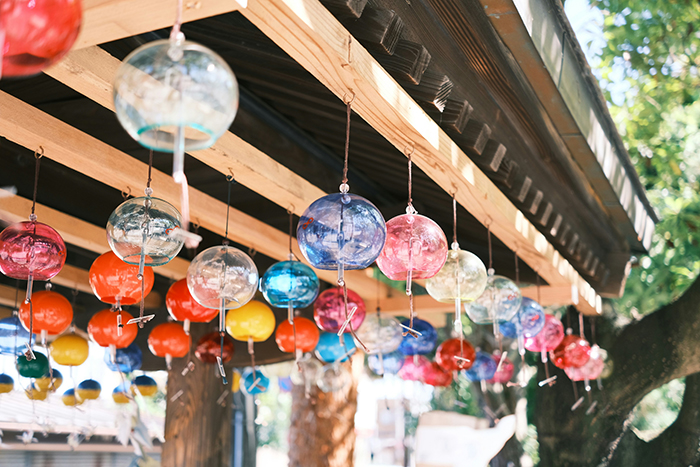
じめじめ jime–jime — damp, humid weather
The particular mugginess of humid air, used especially to describe the 梅雨 tsuyu rainy season in June.
Example:
今日はじめじめしている陽気だから、食事の保存には気をつけよう。
(“It’s so jime–jime today, we should be careful how we store food.”)
ギラギラ gira–gira — harsh, searing brightness
Not simply bright, but bright to the point of stinging the skin. Japan’s summer of 2025 was, this author would say, exactly a giragira summer. A near-relative, きらきら kira–kira, describes light that is beautiful to look at and pleasant to watch. Gira–gira is what kira–kira becomes once the pleasure is gone and only the intensity remains.
Example:
太陽がギラギラ照りつけていて、少し歩くだけでも日焼けしそうだ。
(“The sun is beating down so gira–gira that even a short walk feels like it will burn your skin.”)
シャリシャリ shari–shari — a light, icy crunch
The texture of shaved ice, かき氷 kakigori, or an ice pop. Cafés have lately been serving more cream-based shaved ice, but the classic version, with its coarse, crystalline grain, is the dessert that gives sharishari its meaning.
Example:
このアイスキャンディーはシャリシャリとした食感でとても美味しい。
(“This ice pop has a wonderful shari–shari texture.”)
Autumn
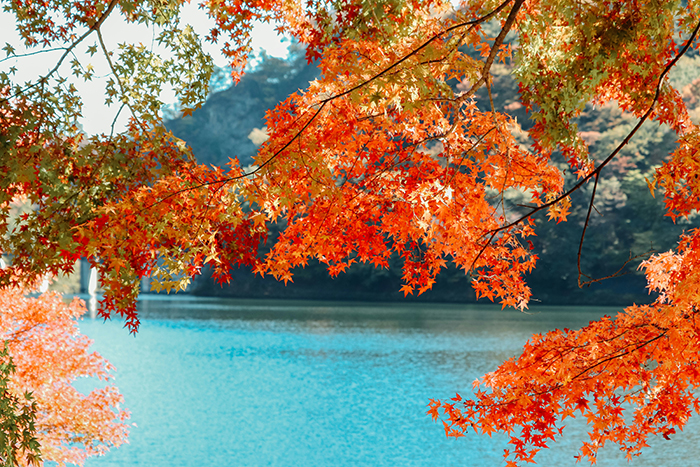
かさかさ kasa–kasa — the sound of dry leaves underfoot
Fallen leaves crunching on the ground. A close relative, がさがさ gasa–gasa, means the same thing but lands as heavier and coarser to the ear.
Example:
かさかさと音を立てながら並木道を歩いていく。
(“I walked down the tree-lined path, kasa–kasa, with every step.”)
ぴいぷう piipuu — the whistle of a cold wind
The north wind blowing around November. It appears in たきび Takibi (“Bonfire”), a well-known Japanese children’s song whose opening line describes the north wind blowing piipuu.
Example:
北風がぴいぷうと吹いてきたから、もうじき冬が近いだろう。
(“The north wind has started blowing piipuu, so winter must be close.”)
さらさら sara–sara — grasses or rice stalks rustling
Rice stalks or grass brushed by the wind. Fields of golden rice swaying sarasara are one of the season’s recurring sights, seen across Japan every autumn.
Example:
稲穂がさらさらと音を立てて揺れていた。
(“The rice stalks swayed and rustled, sara–sara, in the wind.”)
Winter
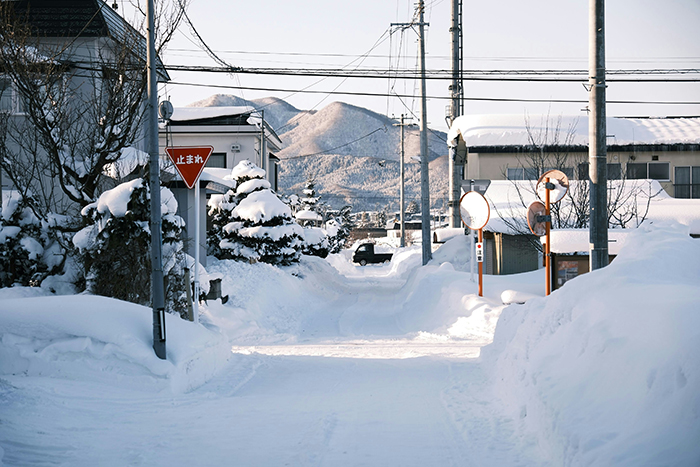
しんしん shin–shin — snow falling in silence
Snow falling quietly and settling, layer upon layer. This author grew up in one of Japan’s heavier snowfall regions, where a shinshin snowfall could make it feel as though sound itself had briefly left the world.
Example:
雪がしんしんと積もっていく。
(“The snow is falling and settling, shin–shin, layer after layer.”)
ひんやり hinyari — a cool touch
Low temperature, or the sensation of something cold against the skin. It also describes cold food — ice cream, shaved ice.
Example:
朝家を出たらひんやりとした空気を肌に感じた。
(“Stepping outside that morning, I felt the hinyari air against my skin.”)
ぶるぶる buru–buru — shivering from cold
Trembling brought on by sharp cold. A near-relative, ぷるぷる purupuru, describes the wobble of something with physical give, jelly, pudding, slime, rather than a body shivering.
Example:
外で待っていたが、あまりの寒さにぶるぶる震えてしまった。
(“I was waiting outside, and the cold was enough to set me shivering, buru–buru.”)
In Closing
Twelve words, four seasons, and in each of them a season heard as much as seen. Onomatopoeia of this kind are tied closely to a way of living organized around the natural world and its changes.
Most people register the seasons first through the eye. Layer the sound and texture carried in a word like shinshin or giragira on top of that, and more of the senses come into play at once, closer, this author would say, to how the season actually feels while it is happening.
KOTO is a journal of Japanese craftsmanship, culture, and the aesthetic sense behind them.
- SHARE
-


( language )