






The Tale of Genji: The World’s First Novel, Its Characters, and the Heian Court That Shaped Them
In a previous article, we introduced 枕草子 Makura no Soshi — The Pillow Book, a work completed in the same period. This time we turn to the book that stands opposite it as the other great work of Heian-period literature: 源氏物語 Genji Monogatari, known in English as The Tale of Genji.
The Tale of Genji is often credited as the earliest known example of what Japan now calls an 「イケメン」ikemen — a handsome, attractive man — rendered on the page. But its appeal is not the glittering life of one beautiful man alone. What makes it endure is how closely it follows the hardship and inner conflict hidden behind that glory.
This article sets the novel against the culture of its own time and against The Pillow Book, and works through why, more than a thousand years later, it still holds readers.
What Is The Tale of Genji?
The Tale of Genji was written by 紫式部 Murasaki Shikibu and completed in the middle of the Heian period (794–1185), in the year 1008. It runs to fifty-four 帖 jo — chapters, or literally “volumes” — making it a long novel by any standard, ancient or modern.
Together with The Pillow Book, it is counted as one of the two great works produced by 女房 nyobo — court women serving in attendance on an empress — during the Heian period.
What the Story Does, and What It Left Behind
The novel follows the romantic entanglements of its central figure, Hikaru Genji, with a succession of women; his own rise to glory and eventual decline; and, after his death, the loves and lives of the generation that follows him. The dynamic between Genji and the women around him, and the character types the book established, went on to shape Japanese storytelling for centuries afterward.
The novel is also credited with establishing one of the foundational ideas in Japanese aesthetics: もののあはれ mono no aware.
The Story, in Brief
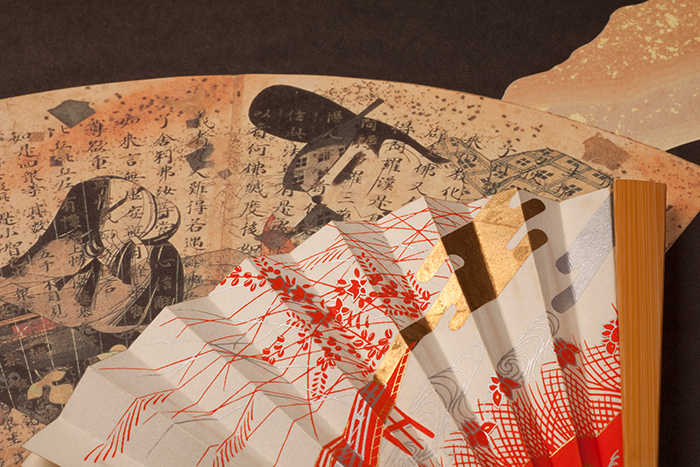
During the Heian period, a beautiful boy was born to the reigning emperor, the Kiritsubo Emperor, and his consort, the Kiritsubo Consort (Kiritsubo no Koi). His mother died when he was three, worn down by the harassment of rival consorts, but the boy grew up gifted with both beauty and talent.
His father considered making him the next emperor, but an oracle warned that his ascension would throw the country into disorder. So the emperor instead gave him the surname 源氏 Genji and lowered him to the rank of subject. From this point he is known by the name that gives the book its title: 光源氏 Hikaru Genji — literally, “the shining Genji” — and it is from here that his life of glittering romance and worldly success begins.
The Main Characters
Character — Reading — Who They Are
|—|—|—|
光源氏 Hikaru Genji — Hikaru Genji — The protagonist. Born a prince, lowered to the rank of subject, he spreads his romantic reputation across the court — handsome, and by his own reputation, something of a playboy.
紫の上 Murasaki no Ue — Murasaki no Ue — Genji’s principal wife. Devoted to him even as his attentions wander to other women. As a child she was known by the name 若紫 Wakamurasaki.
桐壺帝 the Kiritsubo Emperor — Kiritsubo-tei — Genji’s father, and the reigning emperor at the story’s opening.
桐壺更衣 the Kiritsubo Consort — Kiritsubo no Koi — Genji’s birth mother. Loved deeply by the emperor, but driven to an early death by the jealousy and harassment of higher-ranking consorts while Genji was still a small child.
朱雀帝 the Suzaku Emperor — Suzaku-tei — Genji’s older half-brother, crown prince at the story’s opening and later emperor. His mother is 弘徽殿女御 the Kokiden Consort, the chief instigator of the harassment against Genji’s mother. Late in life he entrusts his daughter, 女三の宮 Onna San no Miya, to Genji in marriage.
薫 Kaoru — Kaoru — The protagonist of the story’s final chapters, after Genji’s death. Believed to be the son of Onna San no Miya and Genji — though the story leaves room for doubt.
The Women Genji Loved — Spoilers Ahead
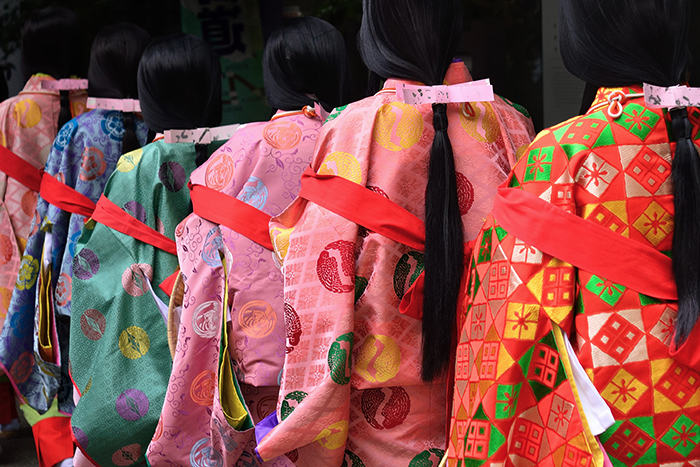
The following is a personal selection by this author of the women whose stories most shape the novel’s direction, drawn from a much longer cast.
Character — Reading — Who She Is
|—|—|—|
紫の上 Murasaki no Ue — Murasaki no Ue — Genji’s principal wife. A relative of Fujitsubo Consort and resembling her closely, she was taken in by Genji as a child and became his wife on reaching adulthood — celebrated for her beauty and her refinement.
藤壺女御 the Fujitsubo Consort — Fujitsubo no Nyogo — A consort of Genji’s father, the Kiritsubo Emperor. Said to resemble Genji’s late mother, she becomes the object of a longing that turns gradually into love. She later bears a son with Genji, who is raised as the Reizei Emperor.
葵の上 Aoi no Ue — Aoi no Ue — Genji’s first principal wife. Proud and cold in manner, their marriage started badly. A living spirit later brings on an illness that takes her life, though her relationship with Genji had improved in her final days. She leaves behind a son, 夕霧 Yugiri.
夕顔 Yugao — Yugao — A gentle woman, formerly involved with Genji’s close friend, To no Chujo. She too dies at the hands of a living spirit.
六条御息所 the Rokujo Lady — Rokujo no Miyasudokoro — A woman older than Genji. Consumed by jealousy as Genji pursues other women, she unknowingly becomes a living spirit and is responsible for the deaths of both Aoi no Ue and Yugao.
玉鬘 Tamakazura — Tamakazura — Yugao’s daughter. Genji takes her in as a guardian figure. Grateful for his protection, she is nonetheless firm in refusing his romantic advances.
朧月夜 Oborozukiyo — Oborozukiyo — A woman involved with Genji’s half-brother, the Suzaku Emperor. A single night’s affair with Genji leads to accusations of treason against him from the Kokiden Consort and her family.
明石の上 Akashi no Ue — Akashi no Ue — A woman Genji meets after moving from 須磨 Suma (present-day Suma Ward, Kobe, Hyogo Prefecture) to 明石 Akashi (present-day Akashi City, Hyogo Prefecture) to clear his name of treason. Genji pursues her ardently, though she is troubled by the difference in their rank. She later bears his only daughter, who is raised by the childless Murasaki no Ue.
花散里 Hanachirusato — Hanachirusato — One of Genji’s wives. Calm and steady, she becomes someone Genji confides in on many matters, and later raises Yugiri after his mother’s death.
末摘花 Suetsumuhana — Suetsumuhana — Genji becomes involved with her after hearing rumors of her, only to be disappointed by her appearance. Though Genji is unsparingly critical of her taste in gifts and dress, she waits for him with quiet devotion.
女三の宮 Onna San no Miya — Onna San no Miya — Daughter of Genji’s half-brother, the Suzaku Emperor. Married to Genji at her father’s request, she becomes pregnant by another man, 柏木 Kashiwagi, who was secretly in love with her.
What Counted as Handsome and Beautiful, in the Heian Court
In the novel, Genji is praised as a handsome man and Murasaki no Ue as a great beauty, while other women are described in far less flattering terms — the description of Suetsumuhana’s appearance, in particular, is unsparing.
The standards involved differ from contemporary Japanese ones in several respects, worth setting out.
For Men
– Family lineage and rank (by far the most important)
– Fair, pale skin and a slender build
– Long black hair
– Elegant bearing and manner of speech
– Skill in composing waka poetry and Chinese verse
– Skill at playing a musical instrument
– Beautiful handwriting
– Good taste in choosing gifts
– Broad cultivation and learning
– A sense of style in dress, matched to season and occasion
– The ability to hold a witty conversation
For Women
– Family lineage and rank (by far the most important)
– Fair skin and lustrous black hair
– A rounded jawline, narrow eyes, and a small, pursed mouth
– Eyelids that are smooth and unswollen
– A somewhat fuller figure, considered more attractive
– Deep cultivation, and wit and elegance in composing and answering waka
– Skill at playing a musical instrument, especially the koto
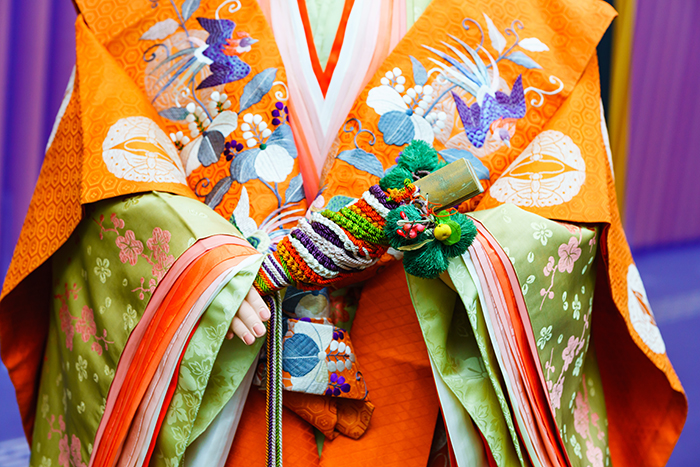
– Taste in dress — above all, in the color combinations of the layered 十二単 junihitoe, the court woman’s formal robe
– Reserve, paired with quickness of wit
This layering technique and its color combinations were known as 襲の色目 kasane no irome, and choosing them well, in a manner suited to season and occasion, was itself expected.
At the time, meeting someone directly and learning their character firsthand was extremely difficult. People instead judged one another by family lineage, by the content of a letter, and by the beauty of the handwriting in it.
That cultivation, musicianship, and taste in dress were all folded into the standard of a handsome man or beautiful woman is, by any measure, a demanding list. In the novel, Genji and Murasaki no Ue meet nearly every one of these conditions, which says something about how much potential the story invests in the two of them.
By contrast, the novel treats an aquiline nose, large eyes, and an overly thin frame — as seen in the descriptions of Suetsumuhana and Tamakazura — as unappealing. Modern Japanese beauty standards favor a slender figure and large, wide-open eyes, which marks a clear break from Heian taste.
The Defining Idea of the Novel: Mono no Aware
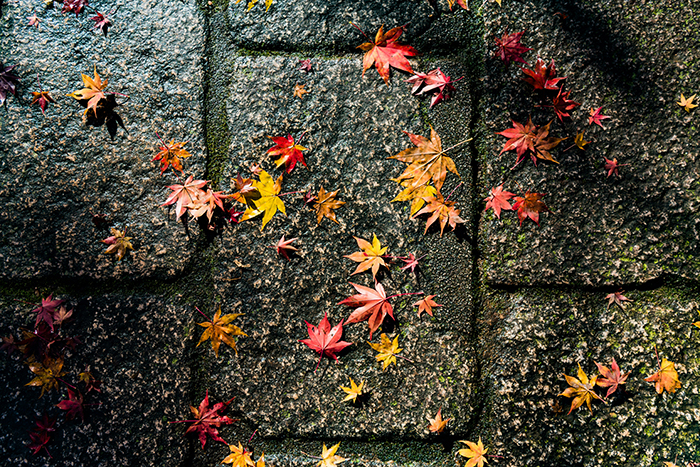
The Tale of Genji is credited with establishing one of the central ideas in Japanese aesthetics: mono no aware.
Mono no aware describes a quiet, deeply felt appreciation of things — a stance of dwelling on something and feeling it fully, rather than reacting to it. It is often accompanied by a sense of 無常 mujo, impermanence: the awareness that things are always in the process of changing, expressed here through fine-grained description of shifting seasons and human feeling.
In contemporary terms, the closest equivalent may be エモい emoi, a colloquial word derived from “emotional,” used to describe something that stirs a quiet, wistful feeling.
Where Mono no Aware Came From, and How It Differs from Okashi
This sensibility is generally attributed to Murasaki Shikibu’s own temperament and to a disillusionment she felt with court life.
The Pillow Book’s central idea, をかし okashi, shares some ground with mono no aware — both describe being moved by something — but okashi is brighter and lighter, closer to delight than to melancholy.
This author’s own sense of the difference: the excitement of cherry blossoms in spring, and the pleasure of viewing them, is closer to okashi. The feeling of an autumn evening, as the days grow short and the season quietly turns, carrying with it a touch of loneliness, is closer to mono no aware.
A Note on “Sensing” and Empty Space

Of the novel’s fifty-four chapters, one stands out: it consists of a title alone, with no text beneath it. That chapter is 雲隠 Kumogakure — “hidden in the clouds.” Immediately after it, the story moves on to Genji’s descendants, and the title itself is understood to imply, without stating it, that Genji has died.
Genji’s final years and his death are, in fact, never described in detail anywhere in the novel. This author takes the choice not to spell everything out — leaving blank space for the reader to imagine the scene — as a telling example of a wider Japanese cultural habit: valuing communication that relies on 察する sassuru, sensing what is left unsaid.
The Author: Murasaki Shikibu
Murasaki Shikibu served as a nyobo to 彰子 Shoshi (also read Akiko), empress consort to Emperor Ichijo. She had studied Chinese poetry and waka since childhood, with a skill her own father is said to have remarked would have brought him great success, had she been born a son.
When she first entered service to Shoshi, she was known as 藤式部 To Shikibu, a name drawn from her father’s surname. After The Tale of Genji became popular at court, she came to be called 紫式部 Murasaki Shikibu instead, after the novel’s heroine, Murasaki no Ue. In 2024, NHK’s flagship taiga drama, 光る君へ Hikaru Kimi e — roughly, “To the Shining One” — dramatized her life.
Heian Culture, as Seen Through the Novel
The Tale of Genji offers a detailed window into the culture and daily life of the Heian court. Knowing the background sharpens both an understanding of Japanese culture and a reading of the novel itself, so we have grouped the relevant customs by topic below.
Marriage and Politics Around the Emperor
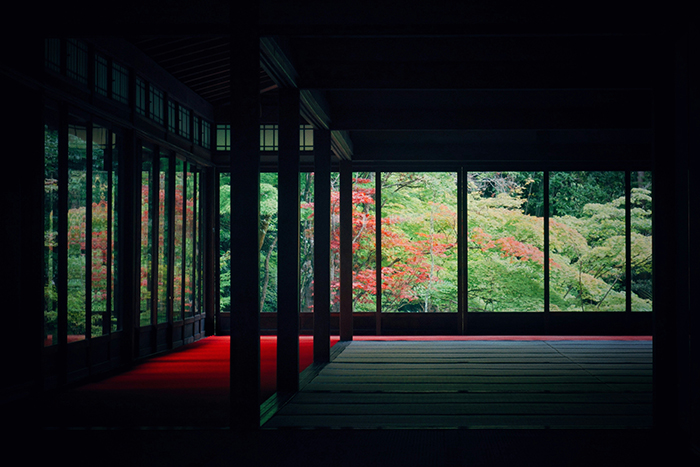
Marriage in the Heian period followed 一夫多妻制 ippu tasaisei, polygyny, in which one husband could have multiple wives — and the emperor was no exception.
A consort who bore the 東宮 togu — the crown prince — would in time become 中宮 chugu, empress, and her family would gain standing as 外戚 gaiseki, the emperor’s maternal relatives. Her father, in particular, stood to gain real political power as “grandfather to the next emperor.” For this reason, noble families competed to have their own daughters sent into 入内 judai — entry into the emperor’s residence, the Heian-period equivalent of marriage to the emperor.
In later centuries, a family’s fortunes rested on producing a male heir. In the Heian period, by contrast, the birth of a daughter was the occasion for celebration, since marrying her to the emperor and having her bear his heir was understood as the surer route to a family’s prosperity.
A note on terms
Term — Reading — Meaning
|—|—|—|
東宮 — togu — The male child in line to become the next emperor.
外戚 — gaiseki — The emperor’s relatives on his mother’s side.
入内 — judai — Entering the emperor’s residence — in effect, marriage to the emperor.
The Rank of an Emperor’s Consorts
An emperor’s consorts were divided into three ranks, from highest to lowest:
Term — Reading — Meaning
|—|—|—|
中宮 — chugu — Also called 皇后 kogo, empress. The emperor’s principal consort, and, by the formal order of rank, his equal.
女御 — nyogo — A rank held by women of imperial blood or by the daughters of ministers. If there was no chugu, the nyogo who bore the crown prince would ordinarily be elevated to that rank.
更衣 — koi — A rank corresponding to the daughters of officials below the rank of major counselor — the lowest standing among imperial consorts.
Genji’s birth mother held the lower rank of koi, yet was deeply loved by the emperor — and it was precisely this that drew the jealousy and harassment of the higher-ranking consorts. The Kokiden Consort, mother of Genji’s half-brother the Suzaku Emperor, was foremost among her tormentors, and her resentment extended to Genji himself.
That resentment ran deep enough that, when Genji later became involved with the Suzaku Emperor’s own consort, Oborozukiyo, the Suzaku Emperor himself was willing to forgive him — but the Kokiden Consort and her family, the Minister of the Right’s household, moved to bring Genji down as a political rival, accusing him of treason. The grudge did not end with Genji’s mother; it reached his son as well.
Do quarreling wives mean quarreling children?
Because one husband could have several wives, discord among them was common in the period. That did not, however, mean that half-siblings were necessarily hostile to one another — and the Suzaku Emperor’s relationship with his younger half-brother Genji makes the point.
When Genji’s affair with Oborozukiyo came to light, the Suzaku Emperor himself was not greatly angered. But his mother, the Kokiden Consort, and her family used the incident to bring an accusation of treason against Genji. As emperor, Suzaku could not overrule his mother’s and his in-laws’ anger, and Genji left the capital for Suma.
Later, in a dream, the spirit of their late father, the Kiritsubo Emperor, appeared to the Suzaku Emperor and rebuked him for it. Overruling his mother’s continued objections, Suzaku recalled Genji to the capital and apologized to him directly.
Caught between his mother and his brother, and reproached even by his dead father, the Suzaku Emperor fell ill with an eye ailment brought on by the stress. A story of illness caused by strain of this kind still reads as familiar today.
Was Genji Royal, or a Commoner?
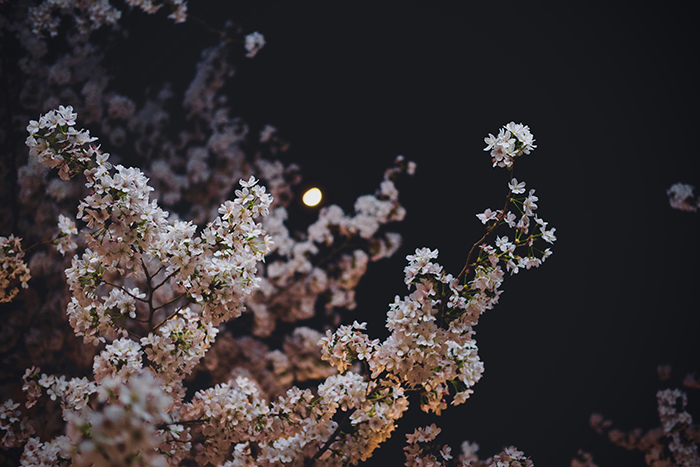
As the emperor’s son, Genji could, in principle, have ascended the throne himself. His father did in fact consider it. Yet through the novel he serves the court alongside other officials, in the position of a subject rather than a prince.
The reason is that the Kiritsubo Emperor ordered Genji’s 臣籍降下 shinseki koka — his demotion from imperial status to the rank of subject.
Shinseki koka refers to the practice of lowering a member of the imperial family to commoner status, to be treated afterward the same as any other retainer. In Genji’s case, the trigger was a prophecy from a fortune-teller of 高麗 Korai — a kingdom on the Korean peninsula, as the story describes it — warning that his ascension would bring disorder to the country.
Historically, shinseki koka is recorded for several other reasons as well:
– To manage the size of the imperial family, whose growth placed a fiscal burden on the state — members of the family who were not in line for succession were periodically moved to commoner status to keep the numbers down
– A female member of the imperial family marrying a commoner and leaving the imperial family as a result (referred to with the character 嫁, meaning “to marry into,” in this specific case)
– Being adopted into a subject’s household and becoming its heir
– As punishment for a crime — plotting treason, taking part in a crime, or practicing a curse against another
Notable Customs in the Novel
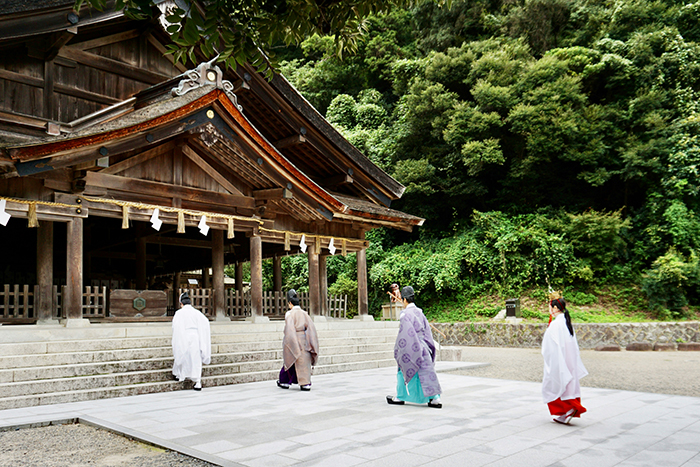
The novel is also a record of Heian-period customs quite different from life in Japan today, grouped here by category.
One: Life Events
Term — Reading — Meaning
|—|—|—|
元服 — genpuku — The coming-of-age ceremony for a young man, marked by dressing his hair and placing a cap on his head. The person who performed the capping, called the 加冠役 kakan’yaku, was regarded in effect as the young man’s guardian.
裳着 — mogi — The coming-of-age ceremony for a young woman, in which she first wore the 裳 mo — a skirt-like garment worn over the junihitoe. It was often performed together with お歯黒 ohaguro, teeth-blackening, and the shaving of the eyebrows.
出家 — shukke — Leaving secular life to enter religious practice. The aim was not only religious — to reach the Buddhist Pure Land after death — but often a way to withdraw from love and political struggle. In the novel, a character’s refusal to allow, or acceptance of, another’s wish to take this step reflects the fact that shukke amounted to a kind of social death; families reportedly wept as if at a funeral when a relative took the step. Men shaved their heads; women cut their hair to shoulder length, in a style called 尼削ぎ amasogi. Convention held that the person would no longer see family or friends afterward, though in practice some who took vows continued something close to their earlier lives.
Two: Working at Court
Term — Reading — Meaning
|—|—|—|
出仕 — shusshi — Dressing one’s hair and presenting oneself at court to take part in the day’s business and meetings — close to what “going to the office” means today.
殿上人 — tenjobito — Someone permitted access to the rooms in 清涼殿 Seiryoden, the hall where the emperor conducted his daily life. Reaching this status was itself a mark of standing in Heian society.
物忌み — monoimi — A period considered inauspicious. Divination under 陰陽道 onmyodo, the practice of yin-yang cosmology, carried real weight at the time, and a person observing monoimi was expected to stay away from court. Because the timing varied from person to person, it was sometimes used as a convenient excuse to avoid attending — the Heian equivalent of calling in sick.
Three: Religion and the Unseen
Term — Reading — Meaning
|—|—|—|
物の怪 — mononoke — Spirits or apparitions, sometimes blamed at the time for illness or fits of hysteria.
夢枕 — yumemakura — An episode in which someone who has died appears at the bedside of a living person in a dream to deliver a message — encouragement in some cases, rebuke or resentment in others.
呪詛 — juso — Calling on the power of a god, buddha, or malevolent spirit to curse another person, aiming to bring them misfortune or death. At the time it was treated as a crime on the order of treason or murder.
Four: Crimes and Punishments
Term — Reading — Meaning
|—|—|—|
謀反 — muhon — Treason: turning against the lord one served — in the novel, the emperor — with force of arms. No actual treason takes place in the story, but Genji is accused of it, over his relationship with Oborozukiyo.
流罪 — ruzai — Banishment to a distant place — a serious punishment. Because the destinations sometimes included remote islands, it was also known as 島流し shimanagashi, “being cast off to an island.” Genji faced the possibility of this sentence over the treason accusation described above.
蟄居 — chikkyo — Confinement to one’s home, without leave to go out — comparable to modern house arrest. Facing the same accusation, Genji chose this course voluntarily, but rather than staying in the capital, he withdrew to Suma.
Love and Marriage in the Heian Period
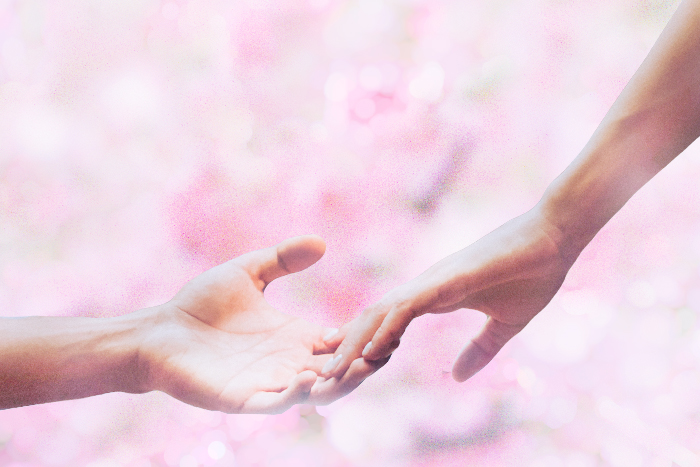
Heian-period couples did not live together as husband and wife in the way that is standard in Japan today. The prevailing arrangement was 妻通婚 tsumadoikon, in which the husband visited the wife at her own family’s residence. Marriage in effect meant the husband marrying into the wife’s family, and it required the approval of the wife’s household to proceed at all.
Here is the process from a first meeting through to marriage.
One: The meeting
Since it was considered improper for a woman to show her face or speak directly in public settings, marriages generally began through an introduction by a third party. A reputation — for beauty, for talent — spreading by word of mouth could also lead a man to fall for a woman he had never met. Genji himself, in many of his relationships, first fell for a woman this way, on reputation alone.
Note: 懸想 kesou means falling in love with someone of the opposite sex.
Two: Exchanging letters
Since direct contact between a woman and a man was likewise considered improper, letters were carried between them by nyobo attending the woman, who sometimes wrote the reply on her behalf as well.
With no chance to see each other’s faces directly, an exchange of letters — carrying a well-composed waka poem, and sometimes a seasonal flower or plant tucked in alongside it — mattered more than anything else. Poor handwriting or a graceless choice of words at this stage could turn the other person against you entirely. Once both sides were satisfied, the man would visit the woman in person, and the two would be joined.
Three: Three consecutive nights
After their first night together, the man had to leave before dawn. Sending a 後朝の文 kinuginu no fumi — a letter written the “morning after” — quickly afterward mattered a great deal: the faster it arrived, the more sincerely a man was judged to be pursuing the woman.
It is tempting to hear an echo of the modern workplace mantra that a fast reply is the mark of someone good at their job — evidently punctuality carried real weight in matters of the heart as well, long before email.
The couple would then spend three consecutive nights together. Genji’s own case was an exception owing to his rank: on the very night of his coming-of-age ceremony, Aoi no Ue — the daughter of a court minister — was brought to share his bed as 添卧 soine, and became his principal wife on the spot.
Four: Recognition by the woman’s family, and marriage
On the morning after the third night, the woman’s family held a banquet. Once the man was accepted there, the couple shared 三日夜の餅 mikayo no mochi — “third-night rice cakes” — together, and the marriage was considered official.
A man’s principal wife was afterward known as his 北の方 kita no kata — “the lady of the north wing” — and addressed by her name with the honorific suffix 上 -ue attached.
The Novel’s Legacy
The Tale of Genji, and Genji’s own love story, has shaped later Japanese culture in several distinct ways.
The Model Couple, Reappearing in Later Stories
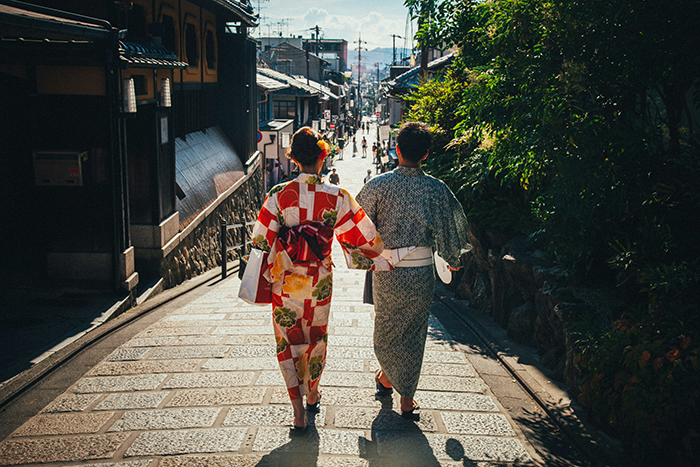
Genji, and his relationship with Murasaki no Ue, became an object of longing for generations of women who read the novel afterward.
In works written after The Tale of Genji was published, a striking man is sometimes described by those around him as “the return of Hikaru Genji,” while a woman lacking in polish is compared to Suetsumuhana.
Genji in particular packs in nearly every quality a woman of the time might wish for — good looks, talent, cultivation, and imperial blood besides. He is a fictional character, but Murasaki Shikibu’s skill in building, more than a thousand years ago, what is recognizably the prototype of the modern Japanese “ikemen” — the idealized, swooned-over leading man — deserves real credit.
A Continuing Source for Manga and Novels
Later generations produced a great many manga and novels drawing on The Tale of Genji, and it also appears in manga form in the classical-literature textbooks used in Japanese junior high and high schools.
Each retelling tends to layer in its own author’s interpretation. This author was struck, in particular, by one high-school textbook manga’s reading of a scene after Genji loses Murasaki no Ue, his great love: the suggestion that all along, he had simply been chasing the memory of his mother’s face, and had only ever wanted to be loved by her.
That a story could carry a truth about human nature that does not change with the era, through the idea of mono no aware, and that a story loved for this long can still yield new interpretations from each generation that takes it up, is part of what makes comparing these retellings so worthwhile.
Namesake of a 1980s Idol Group
A seven-member boy band that debuted in 1987, 光GENJI Hikaru GENJI, swept the country with performances built around roller skates. The name is said to be drawn from Hikaru Genji, though the group in fact began as two separate acts, “Hikaru” and “GENJI,” that were later combined.
Their signature song, “パラダイス銀河” Paradise Ginga (“Paradise Galaxy”), was a major hit and won the Japan Record Award in 1988, the final year of the Showa era. It remains widely used today, including as a cheer song at Japan’s national high school baseball championship, Koshien. One of this author’s former coworkers recalled that, at the height of the group’s popularity, the record was so sought-after it was often sold out.
Beyond “Paradise Ginga,” Hikaru GENJI released other songs still covered by artists today, including 「ガラスの十代」Garasu no Judai (“Glass Teens”) and 「勇気100%」Yuki Hyaku Pasento (“100% Courage”). This author never saw the group perform live, but footage of them gliding across the stage on roller skates carries something of the image of a modern Hikaru Genji, dancing.
The group’s fan club, incidentally, was named 紫SHIKIBU Murasaki SHIKIBU — after Murasaki Shikibu, the novel’s author — rather than 紫NOUE Murasaki NOUE, after Murasaki no Ue, Genji’s wife, which came as something of a surprise on first learning it. The choice is usually put down to how the name sounds aloud, its balance when written in Roman letters, and a preference for the author’s own name — though the exact reasoning remains a matter for speculation.
An Elegant Gesture for the Novel’s 1,000th Anniversary
In 2008, The Tale of Genji marked one thousand years since its completion. To mark the occasion, NHK’s long-running children’s music program, “みんなのうた” Minna no Uta (“Everyone’s Songs”), released a piece called 「光のゲンちゃん」Hikari no Gen-chan (“Little Gen of the Light”), built around the novel’s imagery.
The song follows Genji as he travels a thousand years forward into the present, marveling at how much has changed while still, elegantly, falling in love along the way. That a story could still be loved enough, a millennium on, to inspire a piece like this is, in its own way, a fitting tribute to him.
In Closing: A Story Still Loved in New Forms
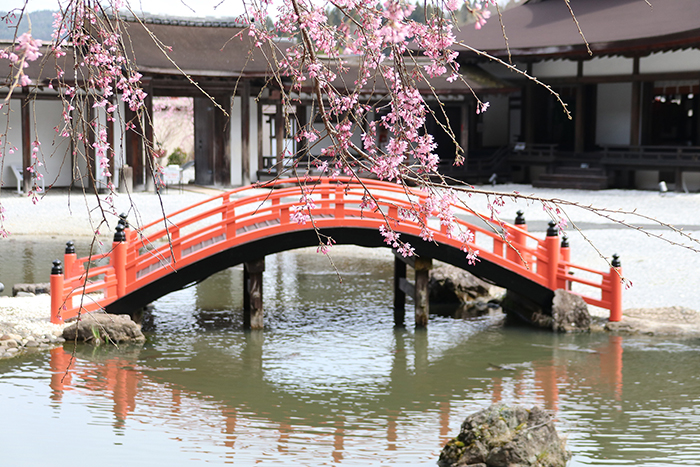
What Murasaki Shikibu built in The Tale of Genji — a record of Heian-period life and human feeling that still speaks to a sense of impermanence, of nothing staying the same — is more than a single article can cover.
The novel today exists in modern-Japanese translations, manga adaptations, and textbook retellings, in versions suited to nearly any reader. If this article gives even one person a reason to pick up one of them, and step into the world of The Tale of Genji and Heian culture, that would be a genuine pleasure.
KOTO is a journal of Japanese craftsmanship, culture, and the aesthetic sense behind them.
- SHARE
-


( tales )