





Edo Shigusa: Was This “Traditional” Japanese Etiquette Ever Real?
“I want to become someone who reads the room.”
Most people have thought this at least once. Being attuned to the people around you — 気配り kikubari, thoughtful consideration — builds easy relationships in business and in private life alike.
But where does a person actually learn it? “I don’t want to fuss over someone to the point that it becomes a burden to them” is a common worry that comes with wanting to learn it in the first place.
To people carrying that wish and that worry, a set of manners called 江戸しぐさ Edo Shigusa has, in the past, been recommended. Packaged as a set of behaviors dense with fine consideration, it was even worked into the moral-education textbooks used in Japanese schools.
For a specific reason, though, the occasions on which it gets cited have fallen away sharply. What, exactly, was wrong with Edo Shigusa? This article sets out to explain the mystery, and to think through it.
What Is “Edo Shigusa”?
Edo Shigusa is a set of considerate behaviors said to have been practiced during the Edo period (1603–1868). It was promoted as a way of extending care and consideration to the people around you without making a show of it. Several of its examples were, at one point, common enough to be used as the subject of public-service commercials and posters put out by Japanese Advertising Council.
The Best-Known Forms of Edo Shigusa
The following gestures are the ones most often cited as Edo Shigusa.
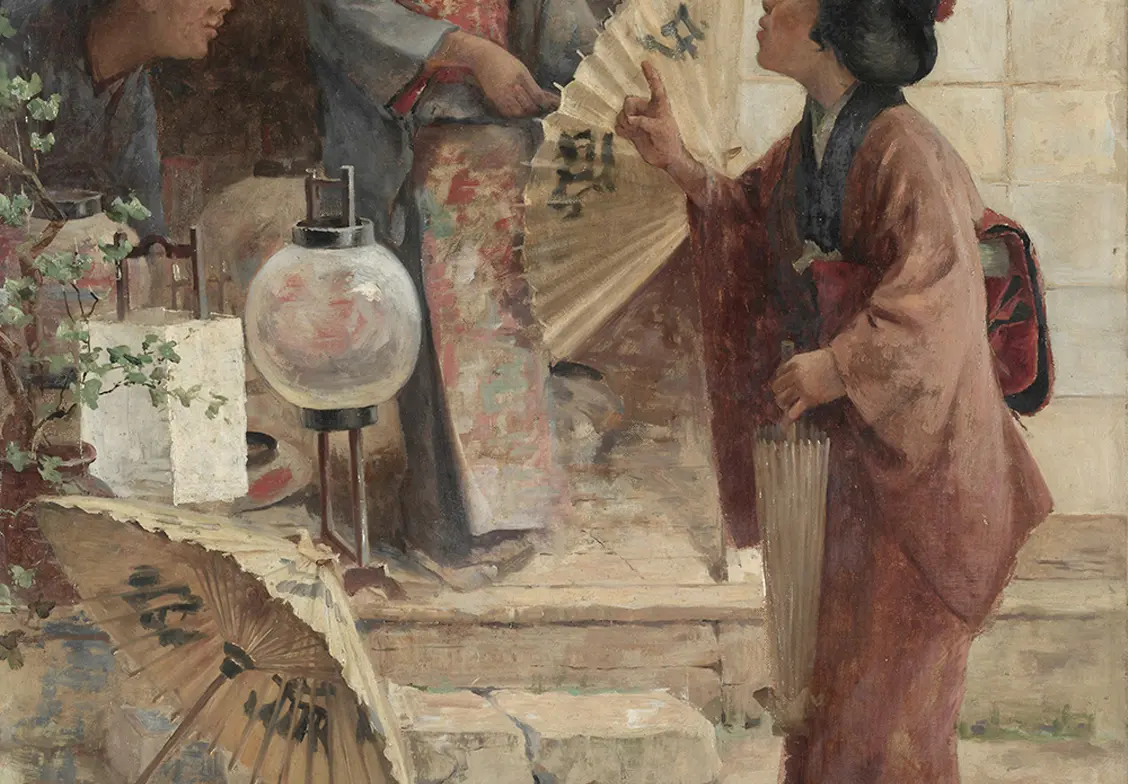
傘かしげ Kasa-kashige — “umbrella tilting.” On a rainy day, when passing another person, tilt your own umbrella away from them, so the two umbrellas don’t collide and so water doesn’t drip onto the other person.
肩引き Kata-hiki — “shoulder pulling.” In a crowd, or on a narrow street, pull your shoulder back as you pass someone, for the same reason as kasa-kashige: to avoid brushing against them.
うかつあやまり Ukatsu ayamari — the “careless” apology. If your foot is stepped on and the other person apologizes, you apologize in return, saying that your own attention wasn’t sufficient either.
うかつ (迂闊) ukatsu describes a state of not paying enough attention — being careless or absent-minded.
こぶし腰浮かせ Kobushi-koshi-ukase — “fist-hip-float.” On a ferry, shifting over to make room for a passenger who boarded later. The name comes from the motion of lifting one’s hip by about the width of a fist to make space.
Did “Edo Shigusa” Not Actually Exist in the Edo Period?
In fact, it has been pointed out that Edo Shigusa did not exist during the Edo period itself.
Its first documented appearance dates to the 1980s. It was proposed by 芝三光 Shiba Mitsuakira, and later popularized by 越川禮子 Koshikawa Reiko, the representative of the NPO Edo Shigusa. The story that “this fine consideration has its roots in the Edo period” was picked up by many media outlets and presented as a beautiful virtue. Around 2014, however, questions began to be raised about whether any historical fact stood behind it.
Why It’s Thought Edo Shigusa Did Not Exist at the Time
① No academic basis has been found. If Edo Shigusa had genuinely existed, some historical record or oral tradition should remain. None has been found. On that basis, it has been argued that the claim that it “actually existed in the Edo period” rests on thin ground.
② The historical setting and the specific gestures don’t line up. The kobushi-koshi-ukase example, described above, is difficult to reconcile with the actual shape of Edo-period boats. Set against the period, it reads more like the kind of consideration used on a modern bus or train.
③ Did it grow into something closer to an urban legend? Some versions of the story go as far as claiming that many Edo residents were killed under the Meiji government, and that Edo Shigusa survived only because it was passed down orally by the few Edo residents who lived on. Critics have described this as treating fiction as history — presenting it as fact and building it into education.
On these grounds, Edo Shigusa began to draw criticism in books and news programs. The effect has lingered: as of 2025, searching “Edo Shigusa” surfaces “lie” and “controversy” among the top suggested search terms.
Where Does the Name “Edo” Come From?
しぐさ (仕草) shigusa means “the words, actions, bearing, and attitude a person brings to doing something.”
So if there’s no academic basis for Edo Shigusa, where does the “Edo” in its name come from? This author’s own view is that the answer likely lies in the social conditions of the 1980s, the decade in which the idea first surfaced.
A note on what follows. From this point on, the article moves into this author’s own reading of the evidence. What follows should be understood as one person’s personal interpretation, not an established account.
Japanese Society in the 1980s
Japan in the 1980s was a country in the early stages of the shift toward the society of the 2020s. Alongside that shift, a number of social changes and difficulties were emerging:
– School violence, bullying, and truancy occurring with growing frequency
– A wave of teen suicides that followed the death of a popular idol singer
– The nuclear family (two parents and children only) becoming the dominant household form
– Rising rates of divorce and single-parent households
– The appearance of families who, even gathered at the same table, ate separately (個食 koshoku) or ate alone (孤食 koshoku, “solitary dining”)
– Alongside a “diversification of individual values,” a decline in people’s sense of attachment and belonging to their local community
– Long hours, late-night labor, and unstable employment becoming ordinary features of working life
Against that backdrop, voices began to worry that society was losing its sense of consideration for others, and that self-centered behavior was becoming more common. Children, in particular, were affected.
Children and a Changing Society
Traditionally in Japan, older children looked after the needs of younger children first, helping them and showing them consideration. Adults in the local community would step in and help as well — the idea that a child was raised by the whole of society, not only by parents, was taken for granted.
If a child misbehaved, it was equally ordinary for adults in the neighborhood, not only the parents, to scold and guide them. The clearest example of this is the 寺子屋 terakoya, the school in Edo-period, where children of different ages sat together in a single classroom and were taught, and taught each other, as a group.
From the 1970s onward, though, a different set of priorities — training talent to sustain Japan’s high economic growth — gradually took over. It came to bear on children more and more directly.
– Attending 塾 juku, cram school, and private lessons from early childhood became ordinary
– Education built around 偏差値 hensachi, standardized deviation scores, allowed for no slippage, not even by a single point
– Children were expected to follow instructions from above instantly and without resistance
– A child’s happiness came to be defined as achieving strong results and abilities superior to their peers
– A child who failed to produce excellent results risked being treated as 落ちこぼれ ochikobore — a dropout
What later came to be criticized as お受験戦争 o-juken senso, the “exam war,” and 詰め込み教育 tsumekomi kyoiku, cram education, wore down the very children who lived through it. The adults who wished for those children’s happiness were, in turn, caught up in their own overwork and in an unstable society.
Did “Giri-Ninjo” Once Run Through the Edo Period?
Consideration for others, and 義理人情 giri-ninjo — duty and human feeling — are surely things people have always felt, somewhere, to be indispensable rather than optional. This author suspects that feeling hasn’t changed, then or now.
But however circumstances unfold, people who have no room left in their hearts tend to turn inward, toward themselves. It’s on that basis that this author reads Edo Shigusa as an attempt to reclaim the giri-ninjo that had once run through the Edo period, and the graciousness associated with the Japanese character more broadly.
Set the household and neighborhood life of the Edo period itself against the 1980s conditions described above.
– Commoners lived in 長屋 nagaya, row houses shared among several households
– Since homes had no baths of their own, neighbors shared a 銭湯 sento, a Japanese public bathhouse
– Drinking water came from a shared 井戸 ido, or well, used in common by neighboring households — the gathering of residents at the well to exchange news and gossip became known as 井戸端会議 idobata kaigi, “well-side conference”
– Poisoning a well, by contrast, was treated as an extremely dangerous and malicious crime, capable of taking many lives in a single community
– Lending and borrowing food and cooking tools among neighbors was an unremarkable part of daily life
Many of the jidaigeki, period dramas, set in the Edo era also take giri-ninjo as their central theme. Taken together, this author suspects that “Edo Shigusa,” as a piece of figurative language, was an attempt to hold on to a giri-ninjo that people sensed was beginning to slip away.
To Be Fair, Something Close to It Did Exist
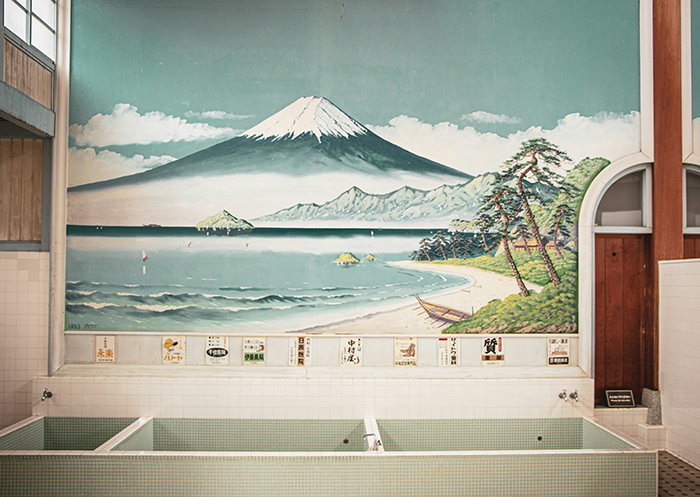
There was, in fact, a phrase from the Edo period itself that comes close to the spirit of Edo Shigusa: 冷え物御免 hiemono gomen.
It was used at the 銭湯, the public bathhouse: someone entering the tub after others were already soaking would use the phrase toward the people already inside. 冷え物 hiemono, “the cold thing,” refers to the speaker’s own body about to enter the water — the phrase is an acknowledgment that one’s own cold body is about to lower the temperature of the bath.
Bathhouses of the period reportedly could not hold their water at a constant temperature, and Edo residents were famously fond of hot baths. It’s out of that cultural setting, most likely, that this small courtesy arose. Its existence, unlike that of Edo Shigusa, can be confirmed in period records of contemporary customs and manners, and in rakugo storytelling of the time.
No Historical Fact, But a Feeling Worth Keeping
As laid out above, it is difficult to say that historical fact stands behind “Edo Shigusa.” On those grounds, presenting it publicly as a manner that genuinely existed in the Edo period would be inaccurate.
At the same time, this author suspects that the phrase “Edo Shigusa” still carries a message worth hearing: that the giri-ninjo of an earlier time is worth cherishing. It’s on that basis that this article has taken up Edo Shigusa as its subject, deliberately, despite the doubts laid out above.
Out of consideration for the other person, we often feel compelled to acquire some sort of special skill first. However, even if our actual conduct misses the mark, surely sincerity and giri-ninjo toward the other person is enough to build a good relationship.
Precisely because the present is a hurried, crowded kind of society, this author wants to hold onto the feeling of giri-ninjo toward others — genuinely, and without needing a historical pedigree to justify it.
KOTO is a journal of Japanese craftsmanship, culture, and the aesthetic sense behind them.
- SHARE
-


( manners )