














Tanabata: Orihime, Hikoboshi, and the Astronomy Behind Japanese Star Festival
Once a year, 織姫 Orihime, the star known as Vega and 彦星 Hikoboshi, the star knnown as Altair are allowed to cross the sky and meet. That is the promise at the center of 七夕 Tanabata, Japan’s summer star festival. Depending on how you look at it, it is also astronomically impossible. It is because Vega and Altair are not moving toward each other at all. They sit about fourteen light-years apart — roughly eighty-six trillion miles — each fixed in its own orbit, and they always have been. 七夕 Tanabata is the night a myth and a fact are allowed to occupy the same sky.
What Is Tanabata? Origins and History


七夕 Tanabata is one of the defining events of the Japanese summer, observed in most of the country on July 7 by the modern calendar, though some regions hold it in August instead, timed to the old lunar calendar.
The origin of 七夕 Tanabata can be traced back to an ancient Chinese festival known as 乞巧奠 Kikkoden. This festival was a ritual in which people prayed to the weaver star for greater skill in weaving, sewing, and related crafts. The custom reached Japan in the Nara period (710–794), where it began as a court ceremony, and by the Heian period (794–1185) it was being widely observed among the aristocracy. It passed through the Edo period (1603–1868) and became a festival of ordinary people, taking root in farming villages as a custom tied to praying for a good harvest and for the health of one’s family — and it is in roughly that form that 七夕 Tanabata survives today.
The Legend of Orihime and Hikoboshi

At the center of the day is the story of 織姫 Orihime — also known as 織女星 Shokujosei, the star we call Vega — and 彦星 Hikoboshi, also known as 牽牛星 Kengyusei, the star Altair.
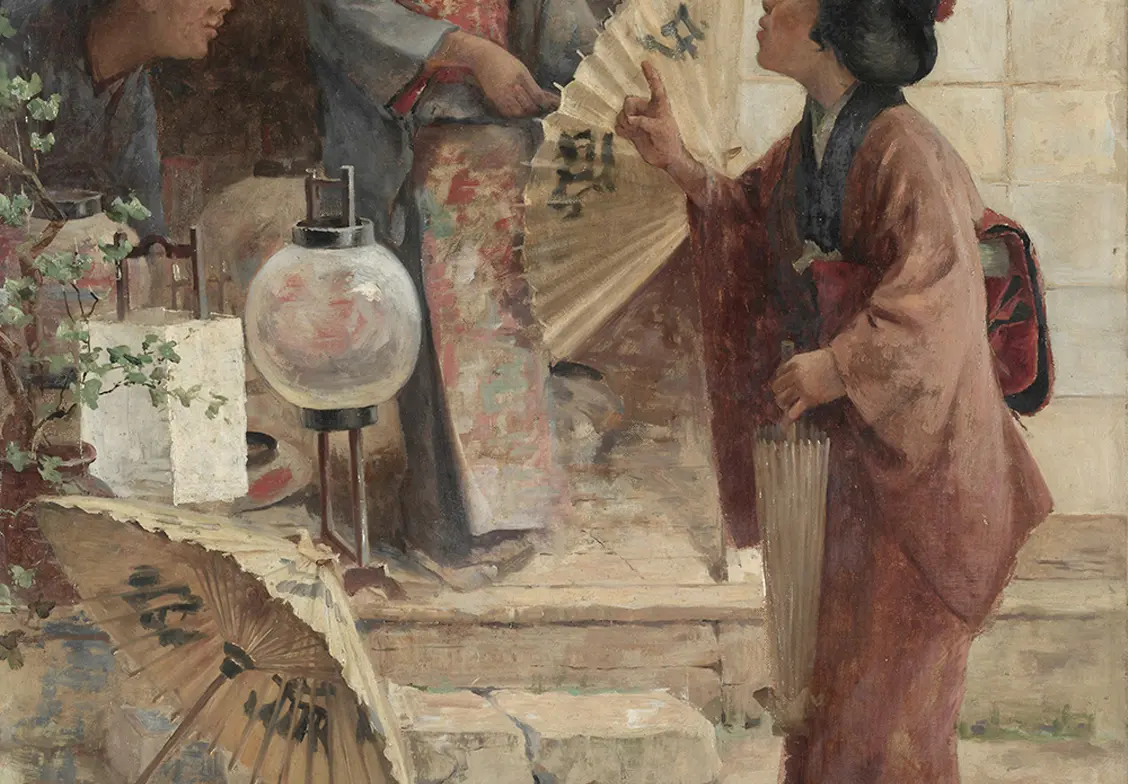
Orihime was a gifted weaver and the daughter of the Heavenly Emperor, tending to her loom every day without fail. Hikoboshi was a hardworking young man who herded cattle on the far bank of the Milky Way. The two were introduced by the Heavenly Emperor and married, but they fell so completely into each other’s company that they neglected their work. This angered the Heavenly Emperor, who separated them, setting the Milky Way between them as a border. He allowed them to meet again only once a year — on the night of 七夕 Tanabata.
The story is not simply a romance. It is also said to carry a warning: that neglecting effort and responsibility costs you what matters most. At the same time, the sight of two lovers determined to cross real distance to be together is read as a symbol of love’s strength, and of hope itself.
Different regions of Japan tell the story with different details. In one version, rain causes the Milky Way to flood, and 織姫 Orihime and 彦星 Hikoboshi can not meet that year.In another version of the legend, a flock of magpies forms a bridge with their wings, allowing them to cross the Milky Way and meet. Whichever version is told, the effect is the same: it gives people a reason to look up at the sky and wish on a star.
The Real Night Sky: Vega, Altair, and the Milky Way


The two stars that light up the 七夕 Tanabata sky, 織姫 Orihime, Vega and 彦星 Hikoboshi, Altair, are in reality separated by about 14.4 light-years of empty space — a gap that even light takes some fourteen and a half years to cross, according to the National Astronomical Observatory of Japan. Vega is a first-magnitude star in the constellation Lyra, about 25 light-years from Earth. Altair is a first-magnitude star in the constellation Aquila, about 17 light-years away. Between them runs the Milky Way — 天の川 Amanogawa, literally “the river of heaven” — a stretch of our own galaxy containing hundreds of billions of stars, visible to the naked eye as a pale band across the sky.
In the myth, the couple meets only once a year. Seen through a telescope, both stars are simply where they have always been, each shining along its own unchanging orbit. “Meeting,” in the literal sense, never happens. What does happen is that in early July, across much of Japan, Vega and Altair both rise close to the zenith at roughly the same time, appearing to stand near each other with the Milky Way running between them — and it is easy to see how that yearly alignment, however coincidental, gave rise to a legend of lovers reunited.
Add a third star, デネブ Deneb, shining between Vega and Altair, and the three together form the shape known as the Summer Triangle. It is a marker of the northern hemisphere’s summer sky, and one that has long served as a signpost for the turning of the seasons. On a clear Tanabata night, myth and astronomy line up in the same patch of sky.
Regional Festivals and Customs
七夕 Tanabata festivals held across Japan are distinguished by the color and decoration particular to each region. At the Sendai Tanabata Festival, brightly colored streamers fill the streets, and large-scale events are also held in cities such as Hiratsuka and Anjo.
At home, the custom is quieter: families tie 短冊 tanzaku, narrow strips of paper to the branches of bamboo and write a wish on each one. What people write ranges well beyond success in school or a prayer for good health, extending to dreams and hopes for the future. The custom of putting a wish into words and sending it up toward heaven is one of the more quietly beautiful habits in Japanese culture.
Where Myth and Science Meet
七夕 Tanabata is a culture particular to Japan in this respect: a love story and the science of starlight cross paths for one night. Because the romance the myth supplies and the facts astronomy provides are allowed to sit side by side, the day carries more weight than an ordinary festival. The wish for Orihime and Hikoboshi to be reunited taps something close to a universal instinct — a longing toward the sky — which is part of why the custom resonates well beyond Japan’s borders.
七夕 Tanabata also travels easily. In places where bamboo is hard to come by, people tie their tanzaku to houseplants or tree branches instead. A wish can be written in one’s own language, or attempted in Japanese. Pair the evening with a stargazing event, and the night delivers both the culture and the science at once.
Part of 七夕 Tanabata‘s appeal is how little it asks of anyone — looking up at the night sky is enough to take part. And knowing the astronomy does nothing to quiet the older instinct: the wish to hand a hope to a star. That, more than anything, is what makes 七夕 Tanabata work — myth and science, meeting each other halfway.
KOTO is a journal of Japanese craftsmanship, culture, and the aesthetic sense behind them.
- SHARE
-


( tales )