





The Tale of the Bamboo Cutter: Japan’s Oldest Story, and Why Princess Kaguya Was Born From Bamboo
The Tale of the Bamboo Cutter — 竹取物語 Taketori Monogatari — is Japan’s oldest surviving narrative, composed in the Heian period (794–1185). Most readers outside Japan know its heroine by another name: Princess Kaguya, かぐや姫 Kaguya-hime, brought to new international attention by Studio Ghibli’s 2013 film The Tale of the Princess Kaguya.
This author first knew her as a picture-book heroine in early childhood, and only later, in the first year of junior high school, read the story under its formal title in a Japanese-language textbook. It has stayed in print, in one form or another, for over a thousand years.
The tale is more than folklore. Its details are woven through with Japanese tradition, and reading them closely is a way into that culture. What follows sets out the story itself, then works through what it reveals.
The Story
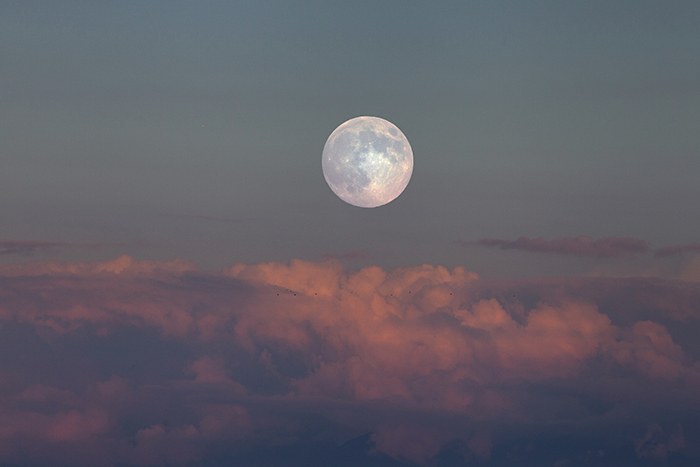
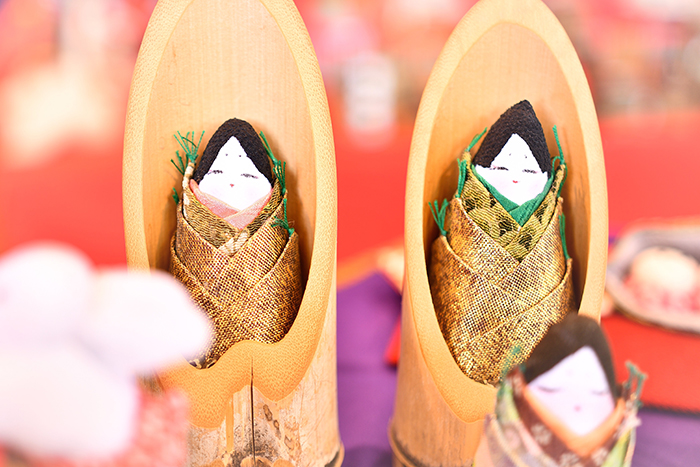
Long ago, an old bamboo cutter — 竹取の翁 taketori no okina — lived with his wife, 媼 ouna. One day, deep in a stand of bamboo, he came upon a stalk that glowed. He cut it open, and inside was a baby girl. Astonished, the couple raised her as their own and named her Kaguya-hime.
She grew into a woman of extraordinary beauty, and noblemen came to court her one after another. She refused them all, but not with a simple no: to each suitor who pressed his case, she set an impossible condition, asking for a treasure whose very existence was in doubt. When word of her reached 帝 mikado — the sovereign, equivalent in the present day to the Emperor — he too proposed. She refused him as well.
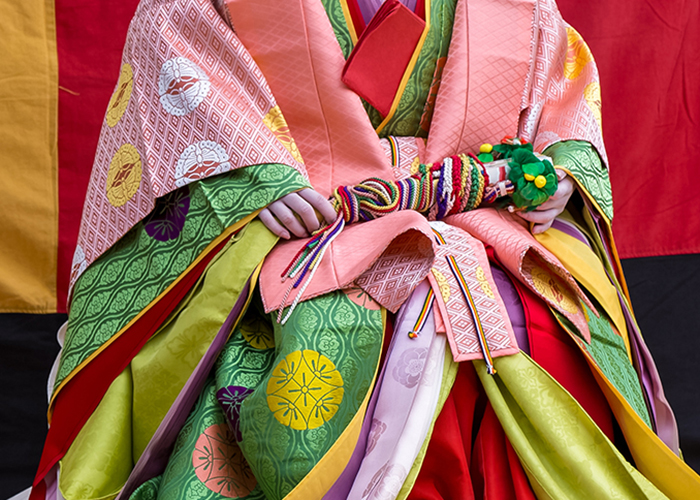
Then Kaguya-hime began looking up at the moon and weeping. Asked why, she told the old couple the truth: she was a being from the moon, and when 十五夜 jugoya arrived — the night of the full harvest moon, the traditional occasion for moon-viewing — she would have to return there. The old couple, the Emperor, and everyone around her did what they could to keep her on Earth, but nothing could be done against the moon’s envoys. Kaguya-hime grieved to part from the couple who had raised her, and left the Emperor a farewell gift, delivered through an attendant: an elixir of immortality. Then she was dressed in 天の羽衣 ama no hagoromo, a robe of feathers, and with it lost every memory of her life on Earth, and returned to the moon.
Reading the Story Through Japanese Culture
A girl born from bamboo who turns out to be a resident of the moon, and who returns there in the end, is a fleeting and dreamlike premise on its own. What gives the story its staying power is how much of Japanese tradition — and how much that still resonates today — is folded into its details.
Why Bamboo?
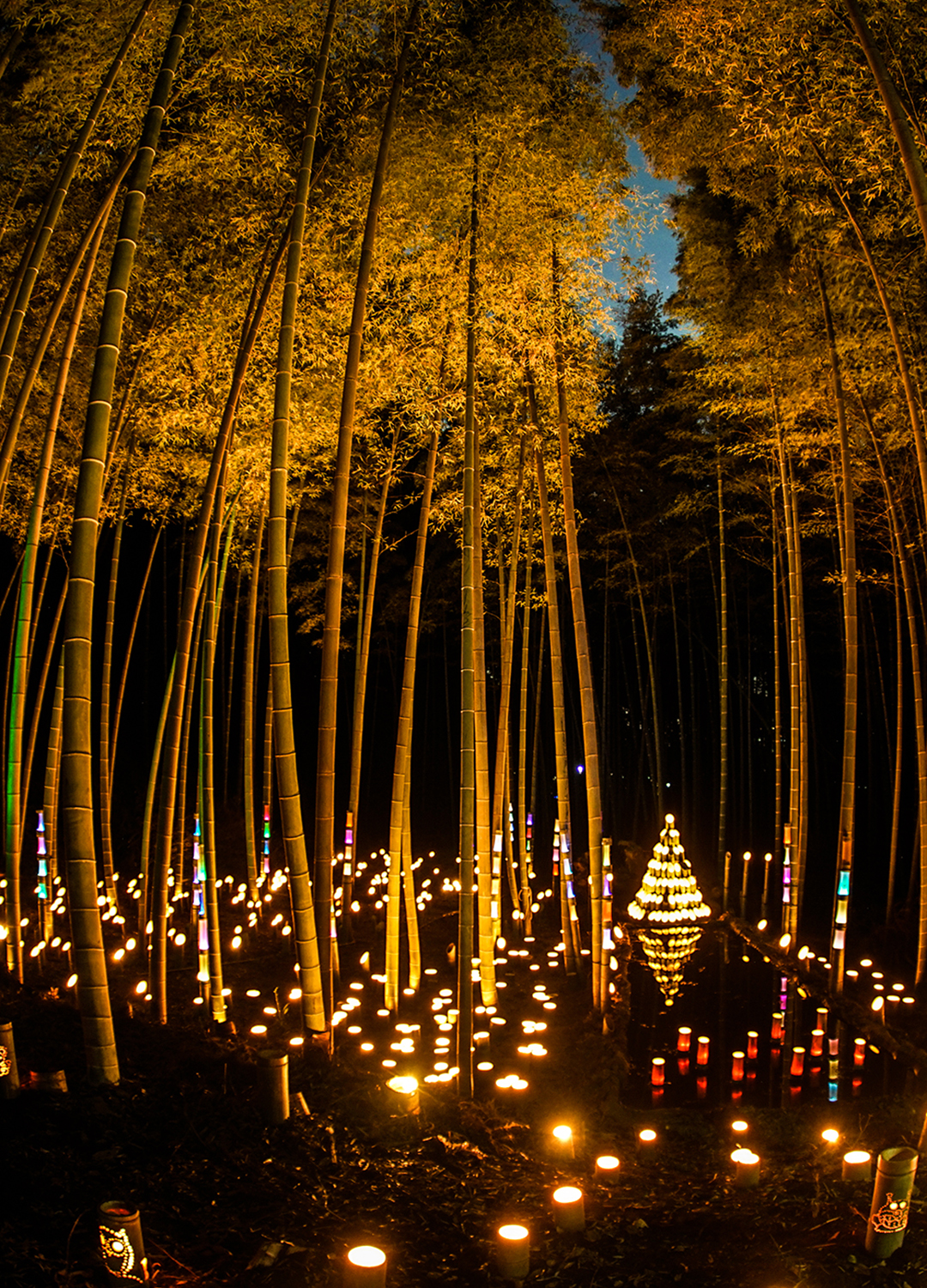
Bamboo has been part of Japanese daily life since antiquity, worked into baskets and household goods of every kind. But its role in the story is not simply that it was common material. Bamboo also carried, and still carries, an air of the sacred, for reasons that recur across Japanese folk belief:
– Unlike most plants, its stalk is hollow, a rare structural trait
– It grows faster than other plants
– Its leaves have a natural antibacterial effect, which read to earlier generations as near-mystical
– It grows straight and strong toward the sky, an image linked to prayers for a child’s growth and health
– The sound of wind moving through a bamboo grove was heard as the voice of a 依代 yorishiro — an object or plant a god is thought to inhabit, standing in for its body
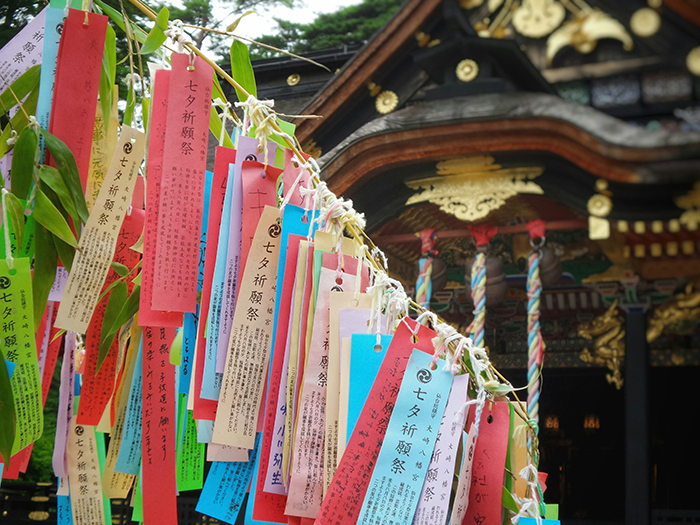
The custom of decorating bamboo and its slender relative 笹 sasa with paper strips at 七夕 Tanabata, the star festival, is thought to descend from the same idea: bamboo as a yorishiro capable of warding off misfortune and carrying wishes up to the heavens.
An Unreachable Woman, and a Longing for the Moon
Several scenes in the story point toward what Kaguya-hime turns out to be: someone unreachable, because she does not belong to the Earth at all.
Five noblemen pursue her in earnest, and she refuses every one. When they will not take no for an answer, she sets her price: bring her the treasure she names, and she will marry him. But the treasures are the kind whose very existence is in doubt. The suitors try to produce them anyway, and each attempt ends badly — one is exposed with a forgery, another is publicly humiliated, and one man dies from the ordeal and the stress of it. In the end, she refuses even the Emperor, whose proposal was, by the standards of the day, the greatest honor obtainable.
Told this way, Kaguya-hime can look wilful. But the sheer number of men she captivates does real work: it dramatizes the moon’s own mystique, and how strongly it draws the Japanese imagination. Once the story reveals where she is actually from, these scenes read less like caprice and more like a portrait of longing for something that can never quite be reached.
The theme outlives the story itself. The Edo-period (1603–1868) haiku poet Kobayashi Issa wrote of a child crying for the moon:
名月を 取ってくれろと 泣く子かな
Give me that harvest moon! — a child, crying.
This author has a private version of the same feeling: riding in a car as a child, sent out at night to collect a cousin from the station, and being struck by how the moon seemed to keep pace with the car outside the window. Near, yet unreachable — and, at the same time, a steady presence lighting the road ahead. Something of that same pull may be what Kaguya-hime carries through the story.
Did This Story Give Mount Fuji Its Name?
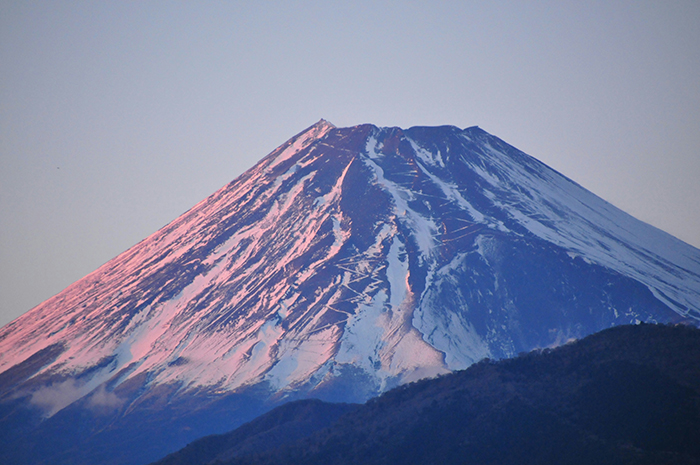
After receiving the elixir of immortality, the Emperor is said to have concluded that immortality meant nothing to him if he could never see Kaguya-hime again. He ordered the elixir burned atop the tallest mountain in Japan, reasoning that it stood closest to heaven.
That mountain came to be called 不死山 Fushi no Yama, the Mountain of Immortality — a name that, in time, is said to have become 富士山 Fujisan, Mount Fuji.
That Mount Fuji already appears in a story from the Heian period is worth noting on its own. It points to how far back the mountain’s status as an auspicious symbol in Japan actually reaches.
Why Did Kaguya-hime Come to Earth?
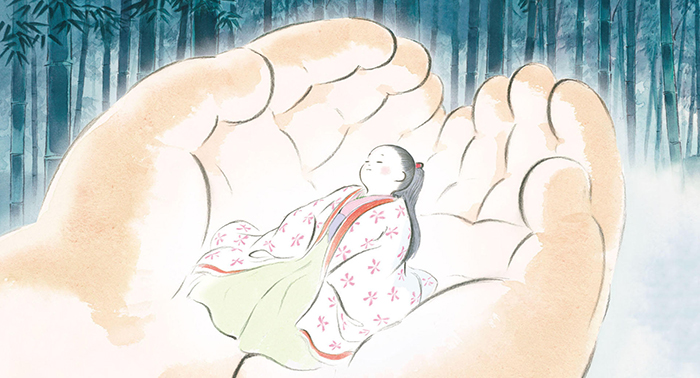
The moon’s envoy gives the old couple one piece of explanation: Kaguya-hime committed some offense while she lived on the moon, and being sent down to Earth was her punishment. The story never says what the offense was, though it has invited plenty of theories.
What follows is this author’s own reading of the question, built around a work that does venture an answer: Studio Ghibli’s 2013 film The Tale of the Princess Kaguya, and in particular its treatment of what her time on Earth meant. The film adds interpretation, scenes, and characters that are not in the original text, and it connects deeply to how the story’s meaning — and the older Japanese sensibility inside it — can be read. What follows draws on both the original tale and the film. Readers who have not seen the film and want to avoid its plot should know that some of it appears below.
At First, She Simply Loved It
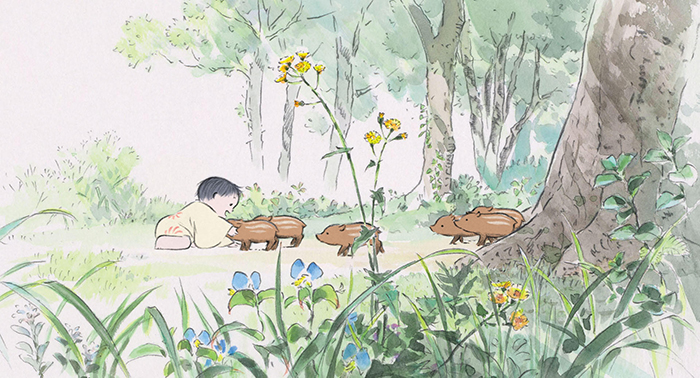
In the film, Kaguya-hime is a being of the moon who nonetheless felt a longing for life on Earth — and it was that very longing, for a place the moon regards as impure, that became her offense. Her punishment was to be dropped to Earth with her memory of the moon erased.
Growing up in the countryside with her earthly parents — the old bamboo cutter and his wife — alongside Sutemaru, a boy invented for the film, and other children her own age, she is unmistakably a girl: innocent, bright, quick to smile. Up to this point, the film is full of exactly the earthly joy and beauty she had longed for.
A Satire of Aristocratic Society, and the Greed for Wealth and Honor
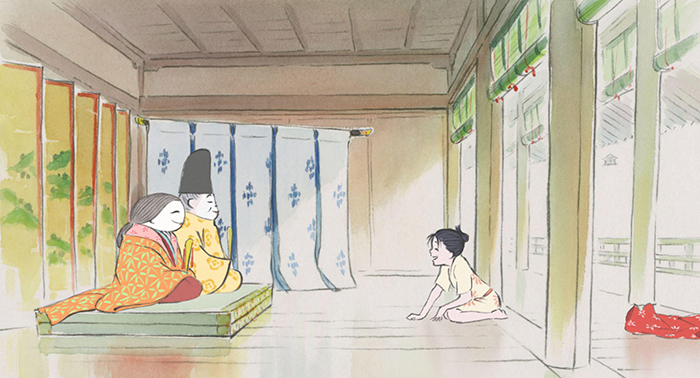
As more treasure kept emerging from the bamboo after Kaguya-hime’s birth, the old bamboo cutter grows steadily more acquisitive. Reading a heavenly sign as an instruction to raise her nobly, he comes to believe that Kaguya-hime’s happiness lies in marrying a nobleman as a highborn princess. He builds a mansion in the capital — present-day Kyoto — and moves the family into a life of luxury.
He forces court manners and behavior on Kaguya-hime, and even when his wife rebukes him for the suffering it causes their daughter, he pays no attention. These scenes are difficult to watch; what makes them bearable is that Kaguya-hime’s earthly mother stays firmly on her side throughout.
The bamboo cutter’s greed, his wife’s rebukes, and the exchanges between mother and daughter are the film’s own invention. But there is a reading of the original Taketori Monogatari that treats its structure as satire of the aristocratic society of its own time — and the complaint that someone gentle turns arrogant the moment they gain status is, evidently, not a new one. The Heian period, it seems, had its own version of the same friction.
Otentosama Is Watching
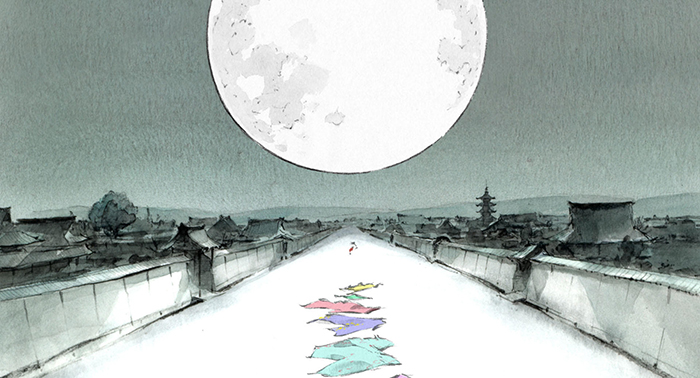
Worn down by mistreatment, Kaguya-hime eventually tears off her court robes and runs from the mansion. In this scene, a large moon hangs ahead of her as she runs — read, in this author’s view, as a double signal: that she belongs to the moon, and that the moon is watching her punishment play out on Earth.
In Japan, a child caught doing something wrong is often warned that お天道様 Otentosama is watching — literally, the sun, invoked as a stand-in for a god who sees wrongdoing even when no person does, and a reason to live honestly regardless. Given that Kaguya-hime’s punishment stems from an offense committed on the moon, it makes more sense here to read “Otentosama” loosely, as the heavens in general, rather than the sun specifically.
She returns to the mansion in the same robes she had thrown off, and from this point behaves properly, her earlier openness sealed away — as if she has begun, without quite realizing it, to accept her suffering on Earth as the price of her offense. From here, the film reads as Kaguya-hime slowly recovering her identity as a being of the moon, without being fully conscious that she is doing so.
An Earthly Death, and Recognizing What Love Really Is
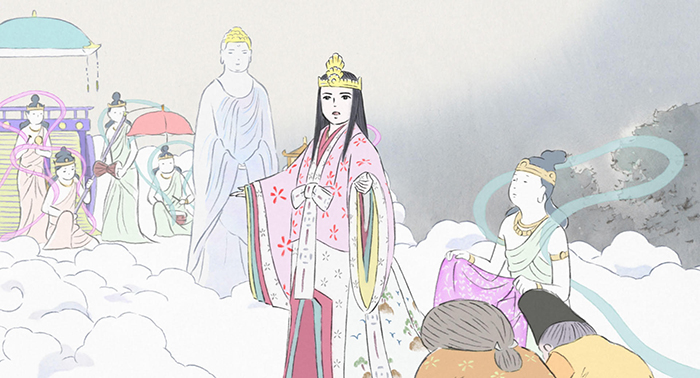
Having faced the pettiness of human hearts again and again, Kaguya-hime finally calls out to the moon for help. The moon, apparently taking this as evidence that she has been punished and has repented, sends its envoy on the night of jugoya.
When the envoy arrives, it appears in the film as Buddhist and celestial figures, and states, without apparent feeling, that returning to the moon means an end to the turmoil of the heart. The scene is often read as a picture of 極楽浄土 Gokuraku Jodo, the Buddhist Pure Land — a paradise where the dead live at peace, undisturbed by emotion. The music that plays here is beautiful and clear, and at the same time strangely without warmth.
And still Kaguya-hime weeps and wants to remain. Her longing to go on living on Earth, feeling everything she feels, even after all she has suffered there, and her resistance to the feathered robe that would erase both memory and emotion, reads as an implicit statement: that leaving Earth is a kind of death.
In this same scene, it is not only Kaguya-hime who weeps and refuses to let go — the old bamboo cutter does too. He and his wife share no blood with her, yet the family the film shows in its opening scenes is warm and close in every way that matters. In this author’s hope, if nowhere else, it is here that the old man finally understands what love and happiness actually are, apart from money or status.
What becomes of Kaguya-hime at the very end of the film is worth discovering directly, rather than being told.
Why the Story Still Matters
Under enough stress, it is natural to wish for a life undisturbed by feeling — calm, at peace, free of emotion’s pull. But it is exactly because we feel things that joy, happiness, and the shock of being moved by an experience are possible at all. That is the case both Taketori Monogatari and The Tale of the Princess Kaguya make for being alive.
It is not a new observation, but it is worth holding onto: to spend time carefully with the people in one’s life, to take things in slowly, and to sit with whatever feeling that produces.
The story is still assigned in Japanese junior high schools today, as the entry point for teaching 古典 koten, classical Japanese — a form of the language distinct enough from its modern counterpart that it is taught as its own subject. That a story from the Heian period is still standard reading a millennium later says something on its own. Part of the reason may be that, alongside its window onto ancient Japanese culture, it carries something that still speaks to Japanese sensibility, and to worries that have not much changed.
The culture, daily life, and mindset of the Heian period run deep through Japanese culture more broadly, and are worth an article of their own — one this author intends to write.
KOTO is a journal of Japanese craftsmanship, culture, and the aesthetic sense behind them.
- SHARE
-


( tales )