










Ashikaga Meisen’s Revival: From a Local Silk to the Paris Runway
Reviving a Nearly Vanished Silk
足利銘仙 Ashikaga meisen, the patterned silk introduced in an earlier article, had once fallen into decline. The company now working to revive it for the present day is ガチャマンラボ Gacha Man Labo.
The project began when a relative running a textile business tried to sell fabric overseas and found there were too few width variations to offer. On a whim, that relative brought along a length of Ashikaga meisen — and was told that if it could be made not in the traditional 着物 kimono width of 36 centimeters but in the roughly 1-meter width used for Western clothing, it would likely find real popularity among high-end brands. That single remark set the project in motion.
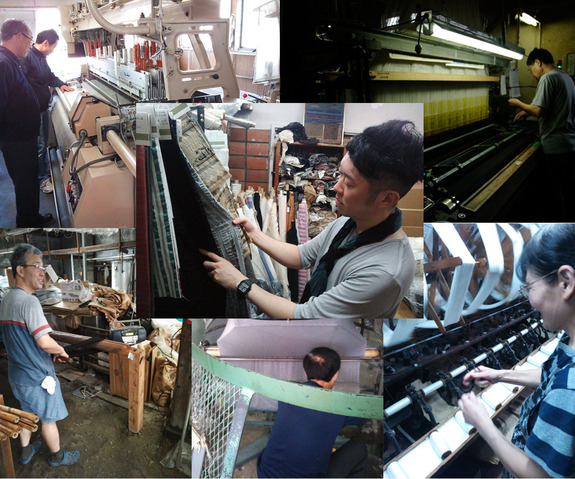
Gacha Man Labo tracked down people who had once worked in Ashikaga meisen production, listened to what they had to say, and researched how the textile might be brought back. Production had always been split across specialized processes, with individual craftsmen handling separate steps, and there was no single point of control that could revive the whole chain at once. Even so, the team restored the process one step at a time, and after roughly eight years, had rebuilt a working production system for Ashikaga meisen.
To the Paris Collection
As trial after trial moved the revival forward, a turning point came when the project won the grand prize at a Tochigi Prefecture business plan contest, and Ashikaga meisen slowly began to be recognized again. Designers from overseas brands and well-known stylists started visiting one after another, and in 2021, Ashikaga meisen was exhibited as a featured fabric of a high-end brand at the Paris Collection, announced to the world and drawing significant attention. Today, it enjoys strong popularity as a fabric that signals a brand’s commitment to its craft.
A Partnership With a Dyehouse
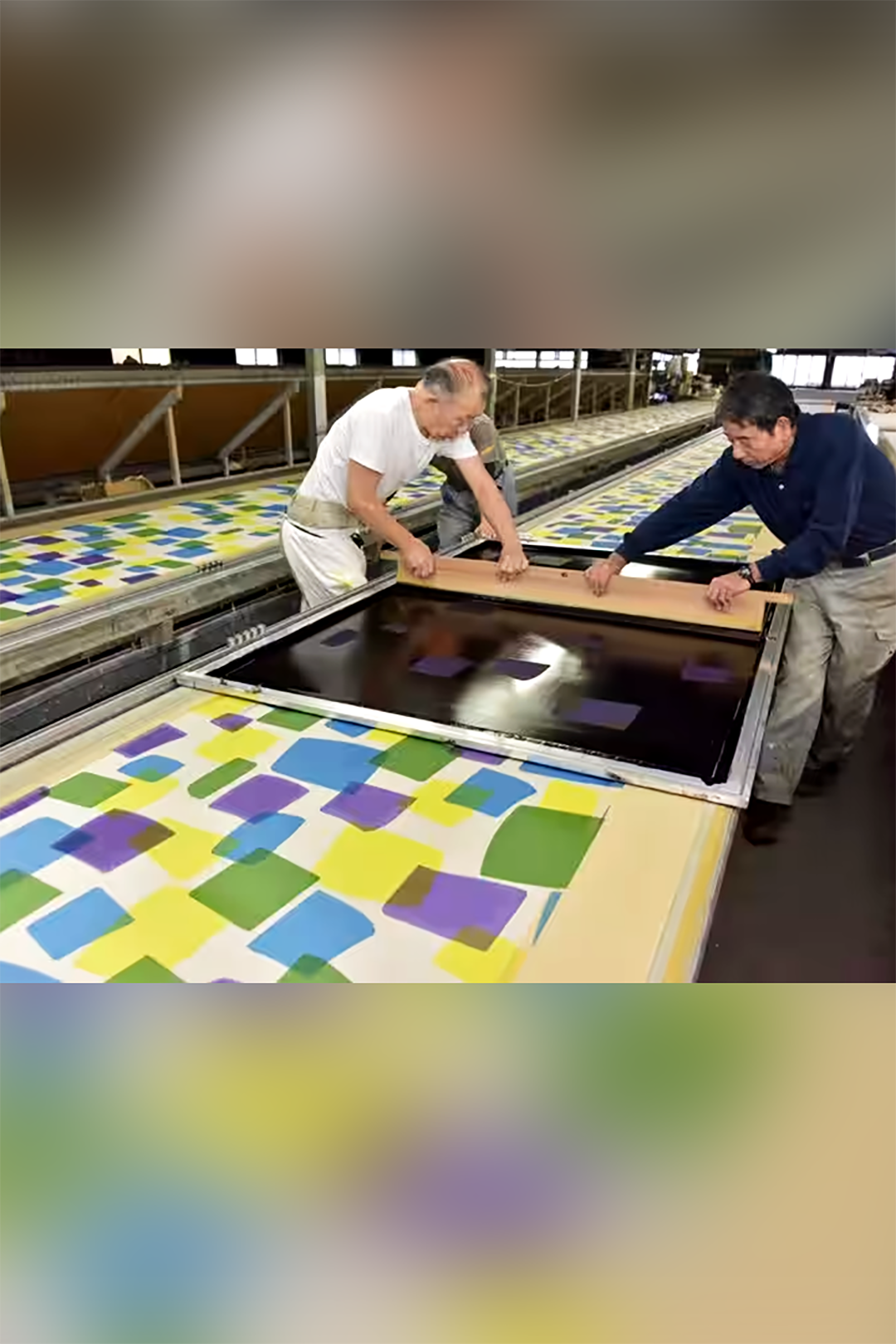
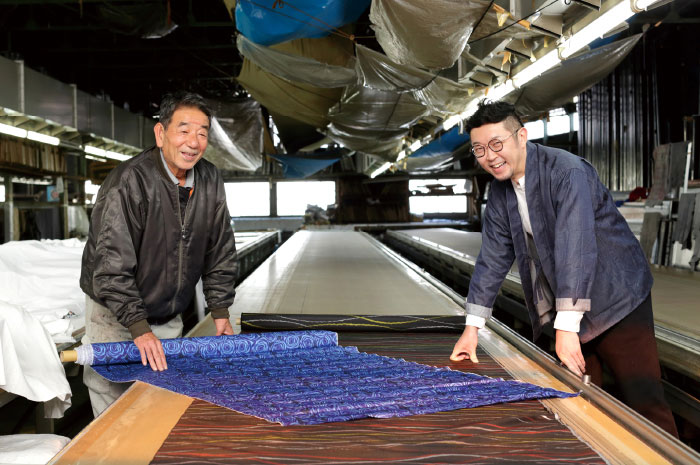
Working alongside Gacha Man Labo on the fabric’s patterns is Tsurugai Masahiro of 鶴貝捺染工業 Tsurugai Nassen Kogyo, a dyeing company. The two have worked together for around six years: Tsurugai Nassen dyes the patterns, and Gacha Man Labo weaves the cloth, with a shared goal of building “the world’s Ashikaga meisen.” Tsurugai had reasoned that dyeing in the wider width used for Western clothing, rather than the narrower kimono width, would sell better — and after repeated failures, became, uniquely in the world, able to print meisen at a width of 1 meter 16 centimeters (about 45.7 inches).
The name “Ashikaga meisen” is now registered with Japan’s Patent Office as a regional collective trademark.
A Problem Facing Japan’s Textile Industry

This is not a challenge unique to Ashikaga; it is playing out across textile-producing regions all over Japan. In Ashikaga, elderly craftsmen still fund the preservation of traditional weaving techniques out of their own pockets — spinning thread, maintaining looms, and keeping them running.
Gacha Man Labo’s representative, Takahashi, had been doing work entirely unrelated to textiles before getting the chance to talk with those craftsmen. Moved by their passion and their sense of purpose, and as someone from a city that had built its prosperity on textiles, Takahashi felt a growing determination to somehow revive the local industry, and began personally searching for ways to sell the fabric.
Takahashi was as much an outsider to textiles as anyone, and at first was not taken seriously by the industry — surrounding voices insisted that Ashikaga’s textile trade was already finished. Along the way, Takahashi learned that within Japan, there were almost no brands positioned, price-wise, to take on the fabric, and made the decision to approach Europe’s leading brands directly. That meant pitching more than thirty companies in person — a path that eventually led to the Paris Collection.
Toward a Revival of Japan’s Textile Regions
Excess fabric inventory is a structural problem across many of Japan’s textile-producing regions. In the wool-and-silk producing 両毛 Ryōmō area that includes Ashikaga, discussed here, an estimated 5 billion yen worth of fabric is said to sit unused.
The apparel industry, structurally, runs on making something new every year — and unless this inventory problem is addressed, Japanese textile industry will continue to decline. It is not enough to wait for recognition from overseas; Japanese people themselves need to take a fresh look at what is made in Japan.
KOTO is a journal of Japanese craftsmanship, culture, and the aesthetic sense behind them.
- SHARE
-


( craft )