




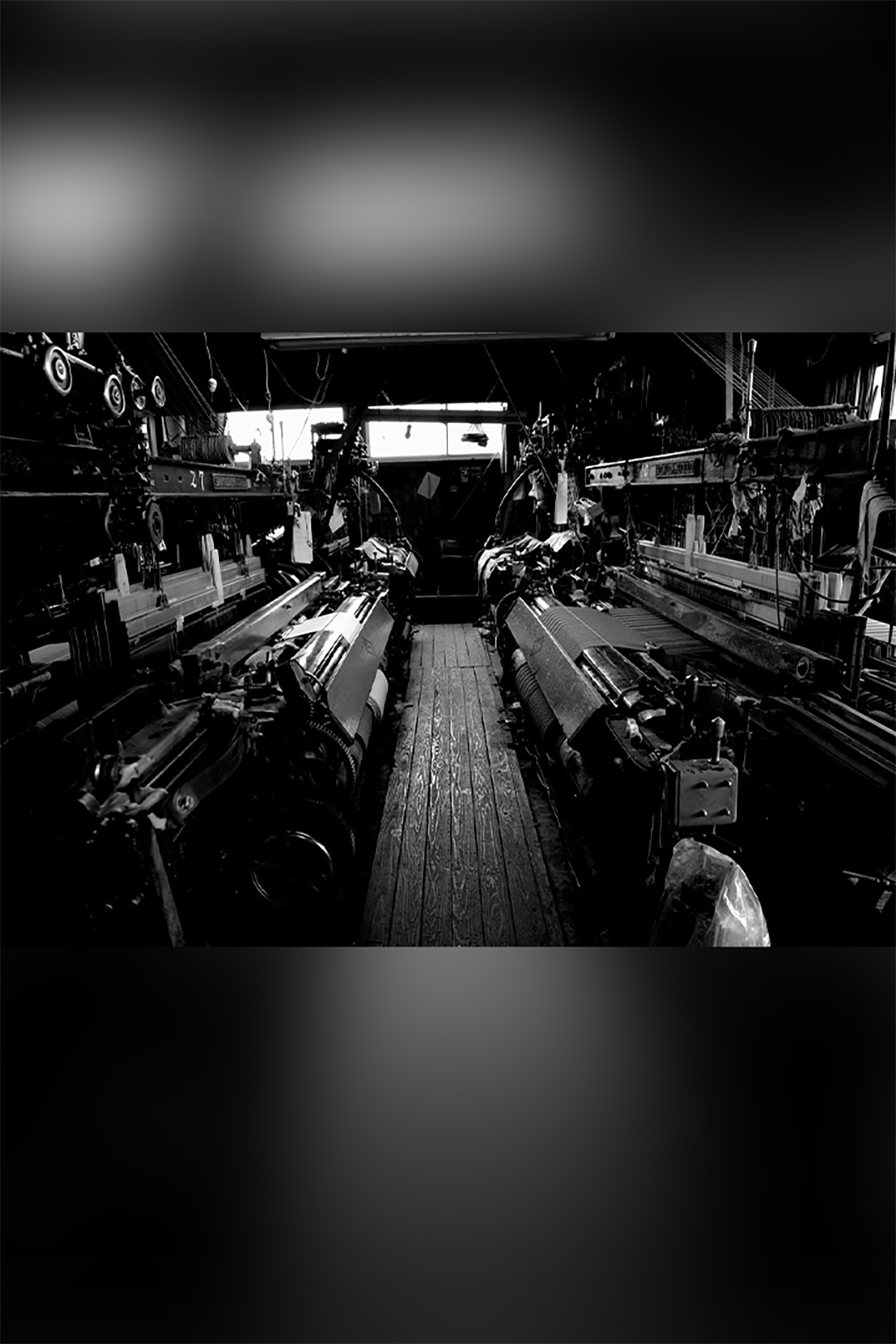
Ashikaga Meisen: The Japanese Silk That Defined the Art Deco Kimono Boom
A Textile Town With a Long History
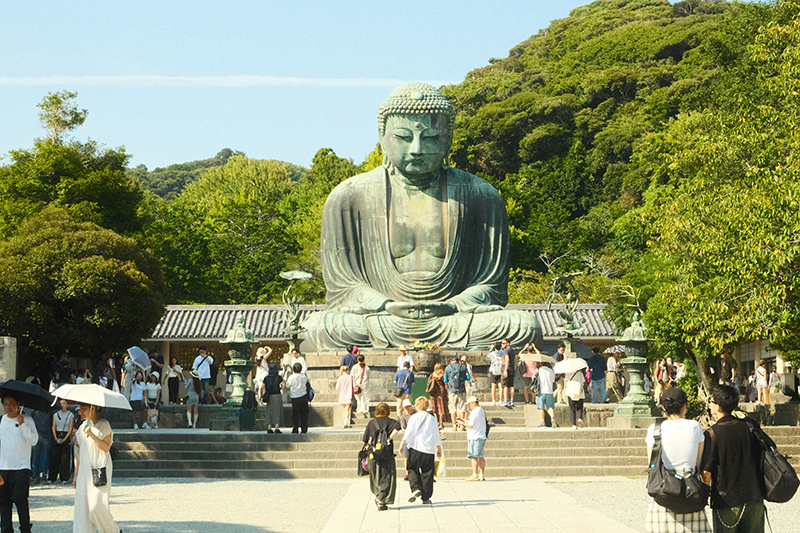
Ashikaga, a city in Tochigi Prefecture, has long been known as a textile town, and it prospered on the strength of that industry. Its history is said to reach back to the Nara period (710–794): according to records kept at the 正倉院 Shōsōin, the Imperial treasure repository in Nara, textiles from Ashikaga were sent as tribute at the time of the Great Buddha’s eye-opening ceremony in Nara.
By the Edo period (1603–1868), cotton textiles had become a larger part of the town’s output, and fabrics such as 足利結城 Ashikaga-Yūki and 木綿縮 momen-chirimen, a crimped cotton crepe, grew popular, and Ashikaga textiles came to be worn widely across Japan.
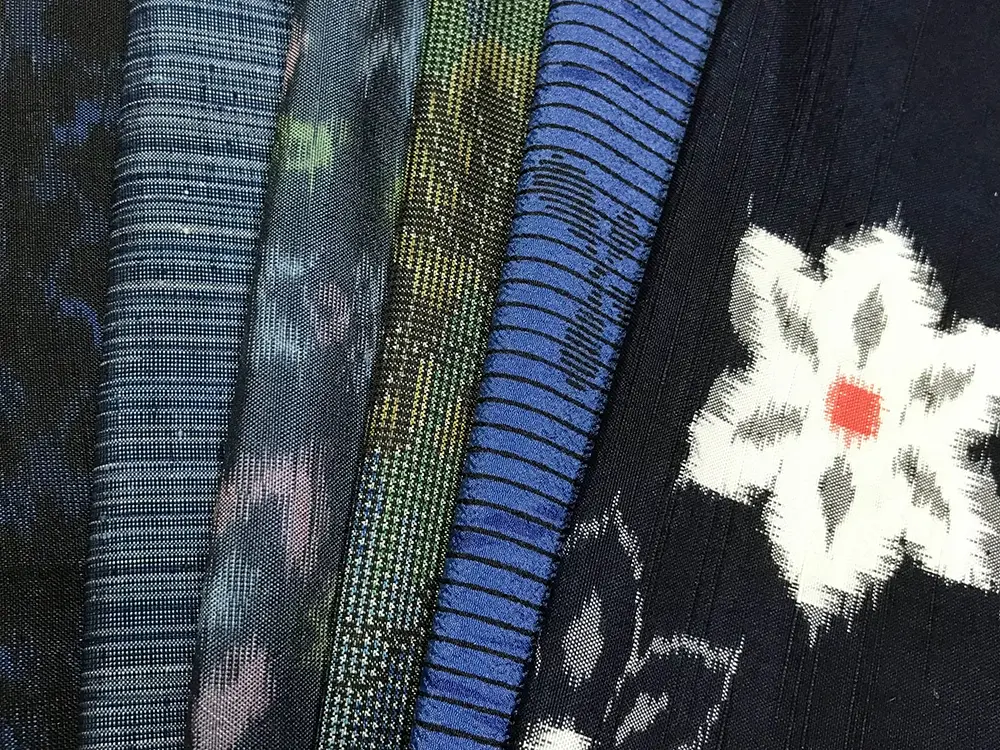
The Meiji era (1868–1912) brought a shift toward silk. Power looms were introduced in Ashikaga, and production methods that had gone largely unchanged were overhauled; the town also worked to expand its exports to markets in America and Europe. By the Showa era (1926–1989), the center of gravity had moved back to the domestic market, and affordably priced silk made using the 解し織 hogushi-ori dyeing-and-weaving technique became the town’s mainstay. Within that category, production of a particularly elegant, boldly patterned cloth — 足利銘仙 Ashikaga meisen — grew steadily, and by around Showa 8–9 (1933–34), Ashikaga meisen was said to have distinguished itself by design alone as the most sought-after meisen fabric in Japan.
What Is Ashikaga Meisen?

Ashikaga meisen is a pre-dyed, plain-weave silk textile produced in Ashikaga, Tochigi Prefecture. It is said to date back to the mid-Edo period. Its original name was 太織り futori, meaning something close to “coarse weave” — a sturdy plain cloth woven with a heavier hand-spun thread known as 紬糸 tsumugi-ito, reeled from cocoons that could not be processed into ordinary silk thread, such as double cocoons and waste cocoons. Being thick and durable, this early cloth appears to have been made mainly for household use.
By the second half of the Edo period, futori had spread among the common people, and samurai wore it as everyday clothing or as a simple, semi-formal garment. It was around this time that the name changed. Because 太 futo, the character for “thick,” calls to mind 太る futoru, “to gain weight” — an unwelcome association for a fabric marketed to women — a new name took its place: 銘仙 meisen.
There are two competing accounts of how that name came about. One holds that because the cloth was woven with a great many warp threads set closely together, it was called 目千 megasen, “a thousand eyes,” or, among weaving specialists, 目専 mesen — and that this was later rendered phonetically as めいせん and written with the characters 銘仙. The other traces it to 銘, the character used in words like 銘茶 and 銘酒 for a fine tea or a fine sake, combined with 仙, which evokes 仙境, a fairyland or realm of immortals, as though the cloth had been woven there. Under this account, the name was chosen for its sound and its luxurious associations, meant to stir consumer desire rather than to describe the cloth literally.
From the late Edo period into the Meiji era, meisen cloth was mostly a solid color. Between the Meiji and Taisho (1912–1926) eras, weavers began deliberately misaligning the warp and weft threads, producing a soft, blurred boundary between colors that became a defining look of the period’s meisen. Ashikaga meisen, in particular, was known for a great deal of 解し絣 hogushi-gasuri, an ikat-patterned variant of this technique. In Taisho 2 (1913), the underlying dyeing method, 解し織り hogushi-ori, was patented — application No. 24612 — by two Ashikaga weavers, Negishi Tōhei and Sekikawa Kumezō. It is now designated a traditional craft of Tochigi Prefecture.
Hogushi-ori: The Technique Behind the Pattern
Hogushi-ori is a warp-dyeing method. Some 1,600 to 1,700 warp threads are set on the loom without letting them slip out of alignment, then loosely woven together with a coarse temporary weft thread. Once a full 反 tan, the standard bolt-length unit of Japanese cloth, has been woven this way, it is unrolled and taken off the loom.
The temporarily woven length of warp thread is then pasted onto a wooden dyeing board, 板場 itaba. Using a separate carved stencil, 型紙 katagami, for each color, the dyer applies a paste mixed with dye by hand with a spatula, working from the darkest color to the lightest to build up the pattern. The cloth is then rolled up, steamed to fix the colors, and returned to the loom, where the temporary weft threads are pulled out one by one as the real weft threads are woven in to complete the cloth.
This technique made a far wider range of patterns possible. Where earlier meisen had relied mostly on kasuri and arrow-feather motifs, hogushi-ori allowed for the curving lines of Art Nouveau and the straight, geometric patterns of Art Deco, as well as abstract, painterly designs and bold floral motifs. Riding this technical breakthrough, and the modern culture of the late Taisho and early Showa eras, colorful 模様銘仙 moyō-meisen, “pattern meisen,” shaped by European fashion design became hugely popular.
Ashikaga Meisen Was Once Cutting-Edge
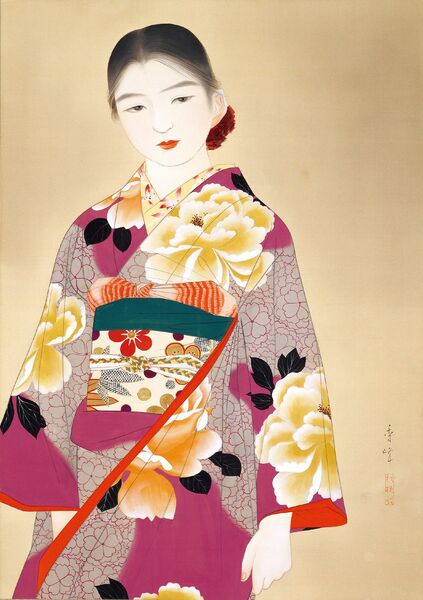
By the start of the Showa era, modern patterns had emerged and Ashikaga meisen’s designs kept evolving — and the town met that moment with what would now be recognized as an early form of PR. It commissioned a leading painter to create a poster of a well-known actress dressed in Ashikaga meisen, and pursued large-scale publicity campaigns of a kind rarely seen at the time. The strategy worked: Ashikaga meisen’s popularity spread across Japan.
But the Pacific War brought a sharp drop in production, and in the wave of postwar Westernization that followed, the fabric fell into decline. A companion piece on KOTO follows what happened next — the modern effort to bring Ashikaga meisen back to life.
KOTO is a journal of Japanese craftsmanship, culture, and the aesthetic sense behind them.
- SHARE
-


( craft )